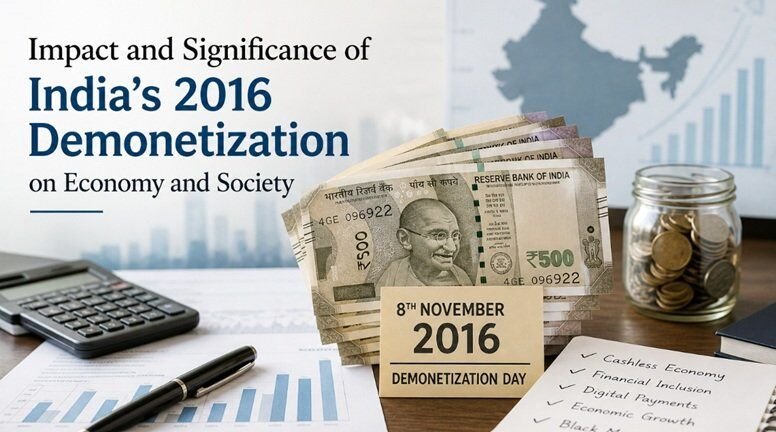
On the evening of 8th November 2016, the Government of India made one of the most significant economic announcements in the country’s history. In a surprise and nationwide televised address, the Prime Minister of India, Shri Narendra Modi, declared that the existing ₹500 and ₹1000 currency notes would cease to be legal tender from midnight of that very day. This meant that these high-denomination notes, which together constituted a major share of the circulating cash in India, could no longer be used for any form of transaction, purchase, or payment.
The announcement took citizens completely by surprise, as there had been no prior indication of such a monumental step. The Prime Minister explained that this move, widely known as “demonetization,” was undertaken as a decisive measure to curb black money, corruption, terror financing, and the widespread circulation of fake currency. He emphasized that the decision was aimed at promoting transparency in financial transactions and encouraging the shift toward a digital and cashless economy. This reflects the importance of understanding economic changes and their impact on daily life.
In the hours following the broadcast, people across the nation rushed to banks and ATMs to exchange or deposit their old notes. The government and the Reserve Bank of India provided citizens with a detailed framework, outlining how and where the discontinued notes could be deposited or exchanged for new denominations of ₹500 and ₹2000. Long queues were observed outside banks as individuals sought to comply with the new regulations and ensure their savings remained valid.
The sudden announcement marked a turning point in India’s financial landscape. Such events highlight the need to adapt to changing economic environments. It triggered intense discussions, both in political and economic circles, about its potential benefits and challenges. Supporters hailed it as a bold and necessary step toward eliminating unaccounted wealth and modernizing the economy, while critics pointed to the hardships faced by common citizens and the short-term disruption in trade and daily life.
Demonetization, as declared on 8th November 2016, thus remains one of the most defining events in India’s recent economic history—a moment when the entire nation collectively experienced a profound transformation in the way cash, currency, and commerce were viewed and managed.
Demonetization
In the place of old currency notes, new Rs. 500 and Rs. 2000 will be in circulation in the banks and in the ATMs. The currency of the remaining denomination will be available as usual in the country.
Why was this step taken by the Reserve Bank of India for the nation?
The demonetization will bring new changes among the people of India by reducing the effect of funding foreign terrorist activities against India, minimizing the level of bribery, and bringing down the presence of black money in the hands of the social countrymen.
The move is a great one as the total currency in circulation amounts to 16.42 lakh crores, whereas only Rs. 500 and Rs. 1000 amount to around 14.18 lakh crores. So the effect is a big boon to the nation.
To help minimize the inconvenience caused by the sudden change in the nation’s monetary system, the government has announced that certain essential services and institutions will continue to accept the old currency notes for a limited period. Petrol bunks, government hospitals, railways, airlines, and several other organizations recognized by the government have been instructed to accept these old banknotes until 24th November 2016. This temporary measure aims to provide citizens with enough time and flexibility to manage immediate financial needs during the transition to new currency notes.
During this period, individuals can still use the old notes to purchase fuel for daily transportation, pay for urgent medical treatments at government healthcare facilities, and buy train or airline tickets for necessary travel. The government’s decision reflects an effort to ensure that essential sectors of the economy remain functional and accessible, particularly for those who may not have immediate access to banking services or alternative modes of payment.
Furthermore, this short-term allowance helps prevent disruption in critical public services and supports the smooth implementation of the larger policy objective—reducing counterfeit currency, curbing black money circulation, and promoting a more transparent financial system. By permitting essential transactions to continue through recognized institutions, the government seeks to balance economic stability with public convenience, ensuring that citizens can adapt to the new monetary regulations without severe hardship during the transition phase.
The Finance Minister of India, Arun Jaitley, has informed that this movement will bring in a better economic and social system, increase the size of the economy and the revenue potential of the country. This underscores the value of developing awareness of financial systems and policies.
The positive effects of this movement have brought out the following impact on society for the common man:
- People are standing in a long queue to collect cash from the ATMs.
- People are gathering in the banks to exchange their old currency notes.
- People holding unaccounted money have brought about the following impact:
- Making gold purchases from the jewelry.
- People started donating money to social and charitable organizations
- Bank customers have distributed their money through multiple bank transactions.
- Black money is dumped to get rid of the same.
It is a well-appreciated norm taken by the Government of India to help improve the currency circulation in the hands of honest people of the country.
However, it will take a few months to get things stabilized in the social network and make things operate as normal.
You may also like to read,