You can work hard for years and still feel like your career is not moving forward.
You deliver results. You meet expectations. You remain consistent. Yet promotions may be slow, opportunities may feel limited, and your next career move may not always be clear.
At the same time, some professionals seem to move ahead faster. They develop valuable skills, take on greater responsibilities, build strong professional relationships, and position themselves for new opportunities.
The difference is often not simply talent or luck.
Career growth requires intentional development.
In today’s professional environment, career growth is no longer something you can safely leave to chance. Technology changes quickly, job requirements evolve, industries transform, and employers increasingly value professionals who can learn, adapt, solve problems, and create measurable value.
A successful career therefore requires more than doing your current job well.
You need to develop relevant skills, strengthen your mindset, improve how you work, build meaningful professional relationships, and make deliberate decisions about where you want your career to go.
This guide will help you:
- Understand what career growth means today
- Identify the skills that support long-term career success
- Develop a growth-oriented mindset
- Improve productivity and professional execution
- Build meaningful professional relationships
- Develop your professional visibility and personal brand
- Create a practical career growth roadmap
- Avoid common career development mistakes
- Build a sustainable system for continuous growth
This guide is the cornerstone of the InPeaks Career Growth Hub, where you can explore practical resources on career development, skills, mindset, productivity, leadership, and professional advancement.
What Is Career Growth in the Modern Workplace?
Career growth is the continuous process of increasing your professional capabilities, experience, value, responsibilities, and opportunities over time.
Traditionally, career growth was often measured by:
- Promotions
- Salary increases
- Job titles
- Greater responsibilities
These outcomes still matter, but modern career growth goes beyond them.
Career growth can also involve:
- Developing relevant and valuable skills
- Becoming better at solving complex problems
- Taking on meaningful responsibilities
- Improving professional judgment
- Adapting to changing technologies and workplaces
- Building professional influence
- Expanding your network
- Changing roles or industries
- Creating opportunities for yourself
A useful way to think about career growth is:
Career growth = increasing your ability to create value and increasing the opportunities available to you.
Two professionals can have the same job title and similar experience while progressing at very different rates. Their differences may come from the skills they develop, the problems they solve, the relationships they build, their visibility, and how deliberately they manage their careers.
Why Career Growth Matters More Than Ever
Technology Is Changing Professional Roles
Artificial intelligence, automation, cloud platforms, data analytics, and digital tools are changing how work is performed.
This does not mean every professional needs to become a technology specialist. It does mean that many professionals need enough digital capability to understand and work effectively with technology.
For example:
- Marketing professionals increasingly work with analytics and digital platforms.
- Finance professionals use automation and financial software.
- Managers rely on collaboration and information systems.
- Operations teams use digital workflows and data.
- Many non-technical roles now require basic digital literacy.
For this reason, continuous digital skills development has become an important part of career development.
Competition Is Increasing
Professionals now have access to courses, certifications, global information, professional communities, and remote opportunities that were less accessible in the past.
This creates opportunity, but it also increases competition.
To stand out, you need to demonstrate more than basic competence.
You need to show that you can:
- Solve problems
- Learn quickly
- Adapt to change
- Communicate effectively
- Deliver results
- Work well with others
Skills Matter Alongside Qualifications
Education and qualifications can provide an important foundation, but they are only part of professional value.
Employers also need to understand what you can actually do.
Practical skills, experience, problem-solving ability, communication, adaptability, and measurable results can strengthen your professional profile.
Career Paths Are Less Linear
Many professionals no longer follow a simple path from entry-level employee to manager and then executive.
Careers can include:
- Role changes
- Industry changes
- Specialization
- Leadership opportunities
- Entrepreneurship
- Freelancing
- Consulting
- Portfolio careers
This makes career planning more important, not less.
Professional Adaptability Has Become Important
No career remains completely unchanged.
Organizations restructure. Technology changes. New roles appear. Some skills become less valuable while others become more important.
One of the strongest forms of long-term career security is therefore the ability to learn, adapt, and remain useful in changing environments.
The Four Core Pillars of Career Growth
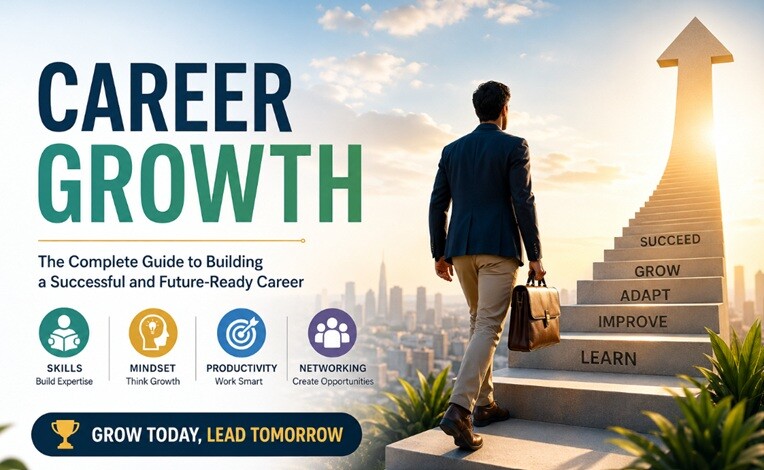
A sustainable career growth strategy can be built around four connected areas:
- Skills – What you can do
- Mindset – How you think and respond
- Productivity – How effectively you turn effort into results
- Relationships and visibility – How people understand and experience your professional value
These areas reinforce one another.
Skills increase your capability. Mindset helps you continue developing. Productivity helps you convert capability into results. Relationships and visibility help your work reach the people and opportunities that matter.
1. Skills Development: The Foundation of Career Success
Your skills determine many of the problems you are capable of solving and the responsibilities you can handle.
Without relevant skills, career growth can become difficult even when you work hard.
Technical Skills
Technical skills are specific capabilities required to perform your role.
Examples include:
- Programming for developers
- Data analysis for analysts and marketers
- Financial modeling for finance professionals
- Project management for project professionals
- Design software for designers
- CRM platforms for sales professionals
Digital Skills
Digital skills allow professionals to work effectively with modern technology.
They can include:
- Digital productivity tools
- Data and analytics
- Automation
- Artificial intelligence
- Cloud platforms
- Digital communication
- Cybersecurity awareness
Explore the complete Digital Skills Guide for a structured approach to developing these capabilities.
Soft Skills
Technical expertise alone is rarely enough for long-term professional success.
Important soft skills include:
- Communication
- Leadership
- Problem-solving
- Critical thinking
- Collaboration
- Emotional intelligence
- Negotiation
- Adaptability
As professionals move into more senior roles, these capabilities often become increasingly important because success depends not only on individual output but also on influencing, communicating, and working effectively with others.
How to Build High-Value Skills
Many professionals consume large amounts of information without developing corresponding practical ability.
A better approach is:
- Identify a specific skill gap.
- Choose a clear learning objective.
- Learn the fundamentals.
- Practice consistently.
- Apply the skill to real problems.
- Seek feedback.
- Improve based on experience.
Learn → Practice → Apply → Review → Improve
This turns learning into professional capability.
Skill Stacking
You do not necessarily need to master dozens of unrelated skills.
Combining complementary skills can create a valuable professional profile.
Examples include:
- Marketing + Data Analytics
- Finance + Technology
- Design + Communication
- Sales + CRM Technology
- Project Management + Data Analysis
- Content + SEO
The combination can make you more versatile and better equipped to solve problems at the intersection of different disciplines.
2. Mindset: The Engine That Drives Career Growth
Skills provide capability, but mindset influences how you respond when circumstances change or challenges arise.
Two professionals with similar skills can produce very different results because they approach learning, failure, feedback, and responsibility differently.
Growth Mindset
A growth-oriented mindset treats ability as something that can be developed through learning, practice, and experience.
This does not mean believing that effort alone guarantees success. It means being willing to improve and learn from experience.
Resilience
Career development rarely follows a perfectly straight path.
There may be:
- Rejected applications
- Missed promotions
- Project failures
- Unexpected changes
- Career transitions
- Periods of uncertainty
Resilience helps you recover, learn, and continue moving forward.
Adaptability
Adaptability means being willing to adjust when circumstances change.
It can involve learning a new technology, taking on a new responsibility, changing your approach, or reconsidering your career direction when necessary.
Ownership
Taking ownership means accepting responsibility for the parts of your career that you can influence.
Instead of waiting passively for someone else to create your next opportunity, look for ways to:
- Develop new skills
- Request useful feedback
- Volunteer for meaningful work
- Improve your performance
- Build professional relationships
- Explore new opportunities
Mindset is not simply motivation. It is demonstrated through repeated behavior.
For more strategies, explore the InPeaks Mindset Hub.
3. Productivity: Turning Effort Into Results
Working longer hours does not automatically produce better career outcomes.
Career growth depends partly on the quality and impact of your work.
Productivity means focusing your time and energy on work that matters.
Key Productivity Areas
- Prioritization
- Time management
- Focus
- Consistency
- Energy management
- Workflow design
Time Blocking
Instead of reacting to every task as it appears, allocate specific periods for important activities.
This can help protect time for deep and meaningful work.
Deep Work
Important career-building activities often require uninterrupted concentration.
Reduce unnecessary notifications, interruptions, and context switching when working on complex tasks.
Eliminate Low-Value Work
Not every task deserves equal attention.
Ask:
- Does this task contribute to an important objective?
- Can it be delegated?
- Can it be simplified?
- Can it be automated?
- Does it need to be done at all?
Build Systems
Good systems reduce the amount of effort required to repeat important behaviors.
For example, you can create recurring systems for:
- Weekly planning
- Learning
- Task review
- Networking
- Career planning
- Progress tracking
Explore the InPeaks Productivity Hub for additional productivity strategies.
The 80/20 Principle
Look for the activities that create disproportionate value.
Your goal is not to be busy. Your goal is to create meaningful results.
4. Networking and Professional Relationships
Career growth is not only about what you know.
It is also influenced by who knows your work, who trusts you, who can recommend you, and who you can collaborate with.
Networking should not be treated simply as collecting contacts.
Strong professional relationships are built through:
- Trust
- Consistency
- Mutual value
- Professional respect
- Meaningful communication
How to Build a Professional Network
- Connect with professionals in your industry.
- Participate in relevant communities.
- Maintain relationships over time.
- Offer help where you genuinely can.
- Share useful information.
- Follow up after meaningful conversations.
The goal is to build relationships before you need them.
5. Personal Brand and Professional Visibility
Your personal brand is essentially the professional reputation and perception you develop through your work, behavior, expertise, and communication.
You do not need to become an online influencer to build professional visibility.
You can build visibility by:
- Doing high-quality work
- Sharing useful knowledge
- Documenting successful projects
- Contributing to professional discussions
- Presenting your ideas clearly
- Helping colleagues solve problems
Visibility should support credibility rather than replace competence.
Capability creates value. Visibility helps others recognize that value.
The InPeaks GROWTH Framework
The InPeaks GROWTH Framework provides a simple structure for managing career development.
G — Gain Relevant Skills
Identify and develop skills that are valuable for your current or desired career direction.
R — Reinforce the Right Mindset
Develop resilience, adaptability, ownership, curiosity, and a willingness to learn.
O — Optimize Productivity
Focus your time and energy on work that produces meaningful results.
W — Widen Your Network
Build genuine professional relationships and contribute value to your professional community.
T — Track Your Progress
Measure your development rather than relying only on feelings.
Track:
- Skills developed
- Projects completed
- Responsibilities gained
- Results achieved
- Professional relationships developed
- Career milestones
H — Harness Opportunities
Use your skills, experience, relationships, and visibility to pursue appropriate opportunities.
The complete model is:
Gain → Reinforce → Optimize → Widen → Track → Harness
Step-by-Step Career Growth Roadmap
Step 1: Conduct a Career Self-Assessment
Before deciding what to do next, understand where you are today.
Evaluate:
- Your strengths
- Your weaknesses
- Your interests
- Your current skills
- Your experience
- Your achievements
- Your areas for improvement
Ask yourself:
What am I good at, what do I enjoy, and what capabilities do I need to develop for the future I want?
Step 2: Define Your Career Direction
You do not need to predict your entire career.
Instead, define a direction.
Consider:
- What type of work do I want to do?
- What responsibilities do I want?
- What skills do I want to develop?
- What type of organization or industry interests me?
- What would meaningful career progress look like?
Step 3: Set Short-Term and Long-Term Goals
Use different time horizons.
Short-term goals: approximately 6–12 months.
Examples:
- Develop a new skill
- Complete a project
- Improve a performance metric
- Take on additional responsibility
Long-term goals: approximately 3–5 years.
Examples:
- Move into a leadership role
- Become a subject-matter specialist
- Change career direction
- Move into a new industry
- Build an independent professional path
Step 4: Identify Skill Gaps
Compare your current capabilities with the requirements of your desired direction.
Identify:
- Skills you already possess
- Skills that need improvement
- Skills you need to acquire
This creates a practical learning roadmap.
Step 5: Build a Learning System
Turn your development goals into recurring habits.
For example:
- 30–60 minutes of focused learning several times a week
- One practical project each month
- A weekly progress review
- A quarterly skills assessment
Consistency usually matters more than occasional bursts of motivation.
Step 6: Increase Your Professional Visibility
Document meaningful work and communicate your contribution appropriately.
Keep track of:
- Projects completed
- Problems solved
- Improvements made
- Positive feedback
- Measurable results
This information can be valuable during performance reviews, interviews, internal applications, and career discussions.
Step 7: Build Strong Professional Relationships
Develop relationships with colleagues, mentors, peers, industry professionals, and people working in areas you want to understand better.
Focus on genuine relationships rather than transactional networking.
Step 8: Take Strategic Opportunities
Career growth often requires leaving familiar territory.
Consider opportunities that allow you to:
- Learn something valuable
- Increase responsibility
- Work with strong professionals
- Solve meaningful problems
- Build credibility
Not every opportunity is worth accepting. Evaluate opportunities based on their learning value, alignment with your goals, risk, and potential long-term benefit.
Common Career Growth Mistakes to Avoid
Waiting for Opportunities
Doing good work is important, but assuming that good work will automatically lead to career advancement can be risky.
Instead:
- Take initiative
- Volunteer for appropriate projects
- Communicate your interests
- Ask for useful feedback
- Make your contributions visible
Ignoring Continuous Learning
Skills can become less relevant as industries change.
Instead:
- Set aside regular learning time.
- Follow developments relevant to your field.
- Develop transferable skills.
- Review your skill gaps regularly.
Having No Clear Direction
It is difficult to make good career decisions if you have no idea what you are working toward.
You do not need a rigid five-year plan, but you should have a general direction and short-term priorities.
Ignoring Relationships
Technical capability is important, but professional relationships can influence collaboration, learning, mentorship, recommendations, and access to opportunities.
Staying in Your Comfort Zone
Doing only what you already know can limit development.
Look for manageable challenges that stretch your capabilities without taking unnecessary risks.
Confusing Busyness With Progress
A full calendar does not necessarily mean a growing career.
Measure progress through meaningful outcomes:
- Skills developed
- Problems solved
- Responsibilities gained
- Results delivered
- Relationships developed
Overworking Without Strategy
Long hours do not automatically create career advancement.
Protect your focus, manage your energy, and concentrate on high-value work.
Career Growth Tools and Systems
Career Development Tools
Useful systems can include:
- Career journals
- Skills inventories
- Learning plans
- Goal trackers
- Achievement records
- Professional portfolios
Productivity Systems
Use simple systems for:
- Task management
- Calendar planning
- Weekly reviews
- Deep-work sessions
- Learning schedules
Career Planning Frameworks
Several widely used frameworks can help structure your thinking.
SMART Goals: Make goals specific, measurable, achievable, relevant, and time-bound.
80/20 Principle: Identify the activities that create the greatest impact.
Eisenhower Matrix: Separate tasks based on importance and urgency.
Skill Gap Analysis: Compare your current capabilities with those required for your target direction.
Real-World Career Growth Scenarios
Scenario 1: The Stagnant Professional
A professional has remained in the same role for several years despite consistently completing assigned work.
Instead of simply waiting for promotion, they:
- Identify skills needed for the next level
- Develop relevant digital capabilities
- Volunteer for meaningful projects
- Improve their productivity
- Communicate their career interests
This creates more evidence of readiness for greater responsibility.
Scenario 2: The Career Switcher
A professional wants to move into a different industry.
They:
- Research the target role
- Identify skill gaps
- Learn relevant skills
- Build practical projects
- Develop a portfolio
- Build relationships in the target industry
This creates a stronger foundation for a career transition.
Scenario 3: The High-Impact Performer
A professional consistently delivers strong results but wants to progress into leadership.
They begin developing:
- Leadership skills
- Communication
- Strategic thinking
- Delegation
- Stakeholder management
They move from focusing only on individual output toward creating value through people, decisions, and broader organizational impact.
Career Growth by Career Stage
Early Career: 0–5 Years
The early stage is primarily about building a strong foundation.
Focus on:
- Learning professional fundamentals
- Developing technical and digital skills
- Building communication skills
- Understanding workplace expectations
- Developing good work habits
- Exploring areas of interest
Goal: Build capability and discover your professional direction.
Mid-Career: 5–15 Years
Mid-career is often about differentiation and increasing professional impact.
Focus on:
- Specialization
- Leadership
- Strategic thinking
- Advanced technical or digital capabilities
- Professional visibility
- Mentoring and collaboration
Goal: Increase your value, influence, and responsibility.
Senior Career: 15+ Years
Senior professionals can increasingly focus on organizational impact and leverage.
Focus on:
- Strategic decision-making
- Leadership
- Mentorship
- Influence
- Knowledge sharing
- Thought leadership
- Developing other professionals
Goal: Create lasting professional and organizational impact.
Advanced Career Growth Strategies
Strategic Positioning
Think about where your skills are most valuable.
Look for intersections between:
- Your strengths
- Your interests
- Industry demand
- Emerging opportunities
The objective is not simply to follow trends. It is to position yourself where your capabilities can create meaningful value.
Continuous Learning
Build learning into your normal routine.
A sustainable system might include:
- Regular weekly learning
- Monthly skill development
- Quarterly career reviews
- Periodic portfolio updates
Build Professional Influence
As your expertise grows, look for ways to increase your influence.
You can:
- Share knowledge
- Mentor others
- Lead projects
- Present ideas
- Contribute to professional communities
Develop Leadership Before You Have the Title
Leadership is not limited to people with formal managerial titles.
You can demonstrate leadership by:
- Taking responsibility
- Helping colleagues
- Solving problems
- Communicating clearly
- Taking initiative
- Making thoughtful decisions
Use AI and Technology as Career Leverage
Technology can support your career when it is used thoughtfully.
Look for opportunities to use appropriate digital tools and AI systems to:
- Reduce repetitive work
- Improve research
- Analyze information
- Organize knowledge
- Improve workflows
- Support decision-making
Technology should enhance professional judgment, not replace it.
Your Weekly Career Growth System
Career development becomes easier when it is part of your normal weekly routine.
A simple weekly system could include:
- 3–5 hours: Learning and skill development
- Focused work: Prioritize high-impact responsibilities
- Relationship building: Maintain meaningful professional connections
- Progress review: Record achievements and lessons
- Planning: Identify the most important priorities for the next week
The exact amount of time is less important than consistency.
Small improvements repeated over months and years can produce significant professional development.
A Simple 90-Day Career Growth Plan
Days 1–30: Gain Clarity
- Assess your current skills.
- Review your recent achievements.
- Define your career direction.
- Identify your biggest skill gaps.
- Choose one or two priority development areas.
Days 31–60: Build Capability
- Follow a structured learning plan.
- Practice your priority skills.
- Apply them to real work or projects.
- Ask for feedback.
- Document your progress.
Days 61–90: Create Visibility and Opportunity
- Complete a meaningful project.
- Document the results.
- Share relevant insights.
- Strengthen professional relationships.
- Look for appropriate new responsibilities.
- Review your next development goal.
This creates a repeatable cycle:
Assess → Learn → Apply → Demonstrate → Review → Improve
How to Measure Career Growth
Career growth should not be measured only by salary or job title.
Consider tracking:
- New skills developed
- Projects completed
- Problems solved
- Responsibilities gained
- Leadership opportunities
- Professional relationships
- Measurable results
- Feedback received
- Career opportunities created
These indicators provide a broader view of whether your professional value is increasing.
Frequently Asked Questions About Career Growth
What is career growth?
Career growth is the process of improving your skills, experience, professional value, responsibilities, and opportunities over time.
How can I grow faster in my career?
Focus on relevant skills, deliver meaningful results, improve productivity, build strong professional relationships, communicate your contributions, and take appropriate initiative.
What skills are most important for career growth?
The right skills depend on your profession and goals. Technical skills, digital skills, communication, problem-solving, leadership, adaptability, and collaboration are broadly useful across many careers.
How important is mindset in career success?
Mindset influences how you respond to challenges, feedback, change, and learning. A growth-oriented mindset can support continuous development, although mindset works together with skills, experience, execution, and opportunity.
Can career growth happen without changing jobs?
Yes. Career growth can happen through increased responsibilities, internal promotions, skill development, leadership opportunities, larger projects, specialization, and greater professional impact.
Should I change jobs to grow my career?
Not necessarily. Consider changing jobs when another opportunity provides a meaningful improvement in areas such as responsibilities, learning, career direction, work environment, compensation, or long-term opportunity. A job change should support your broader career strategy rather than simply being a reaction to temporary frustration.
How do I create a career plan?
Start by assessing your current position, defining a direction, identifying skill gaps, setting short- and long-term goals, creating a learning system, and reviewing your progress regularly.
How often should I review my career goals?
A quarterly review is a practical starting point. You can also make smaller adjustments during your weekly or monthly reviews as circumstances change.
What is the biggest career development mistake?
One of the biggest mistakes is treating career growth as something that will happen automatically. Consistent learning, meaningful work, relationships, visibility, and deliberate career decisions can help you take greater ownership of your development.
Conclusion: Take Control of Your Career Growth
Career growth is not automatic.
It is the result of continuous learning, meaningful work, thoughtful decisions, strong relationships, and the willingness to adapt.
You do not need to transform your career overnight.
Start by understanding where you are.
Decide where you want to go.
Identify the skills you need.
Build a consistent learning system.
Improve how you work.
Build relationships.
Make your contributions visible.
Take appropriate opportunities.
Then repeat the process.
The InPeaks GROWTH Framework provides a simple way to remember the process:
Gain relevant skills → Reinforce the right mindset → Optimize productivity → Widen your network → Track your progress → Harness opportunities.
Your career is not defined by a single promotion, job title, or achievement.
It is built through the capabilities you develop, the value you create, the relationships you establish, and the decisions you make over time.
Start where you are. Build what matters. Keep improving. Take control of your career growth.
Continue Your Career Growth Journey
This guide is the foundation of the InPeaks Career Growth topic.
Continue exploring practical resources on skills, mindset, productivity, professional development, leadership, and career advancement through the Career Growth Hub: Skills, Mindset & Productivity for Long-Term Success.
You can also continue with these related pillar guides:
- Digital Skills: The Complete Guide to Building Future-Ready Professional Success
- Mindset: The Complete Guide to Building a Powerful Mindset for Success and Growth
- Productivity: The Complete Guide to Achieving More with Focus, Systems, and Smart Execution
Build your skills. Strengthen your mindset. Improve your execution. Build meaningful relationships. Keep growing.