Productivity is often confused with being busy.
A full calendar, long working hours, and a constantly growing task list may make you feel productive, but they do not necessarily mean you are making meaningful progress. True productivity is about directing your time, attention, energy, and resources toward work that matters.
The most effective professionals don’t simply try to do more. They learn how to:
- Focus on high-impact work
- Prioritize what matters most
- Eliminate unnecessary distractions
- Manage time and energy effectively
- Build systems that make good habits easier
- Use technology to reduce repetitive work
- Execute consistently
- Review and improve their approach
Productivity therefore isn’t about squeezing more tasks into every hour. It is about making better decisions about what deserves your attention and how you execute it.
In today’s professional environment, this matters more than ever. Employees, entrepreneurs, managers, freelancers, and business owners all face competing priorities, constant communication, digital distractions, and increasing expectations.
Better productivity can help you perform more effectively, manage your workload, develop professionally, and create more space for life outside work.
This guide explains the principles, systems, frameworks, and practical strategies you can use to build a sustainable productivity system.
It covers:
- What productivity really means
- Why productivity matters for career growth
- The five core pillars of productivity
- Focus and deep-work strategies
- Time and energy management
- Systems and habit building
- Productivity tools
- The InPeaks P.E.A.K. framework
- Common productivity mistakes
- Productivity strategies for different career stages
- A practical daily and weekly productivity system
This guide is the cornerstone of the InPeaks Productivity Hub, where you can explore additional resources on focus, systems, tools, and performance.
What Is Productivity in the Modern World?
Productivity is the ability to produce meaningful results through the effective use of time, attention, energy, and resources.
It is not simply about completing more tasks.
It is about completing the right tasks and creating meaningful outcomes.
For example, answering 50 emails may feel productive. But if spending an hour planning an important project could create significantly greater value, email volume is not the best measure of productivity.
A productive approach asks:
What is the most valuable thing I can accomplish with the resources available to me?
Modern productivity therefore involves several connected capabilities:
- Prioritizing high-value work
- Managing time effectively
- Protecting attention
- Managing energy
- Building repeatable systems
- Developing useful habits
- Reducing unnecessary work
- Using technology appropriately
- Reviewing results and improving continuously
Two professionals can work for the same number of hours and achieve very different results because they prioritize and execute differently.
Productivity Is About Effectiveness, Not Activity
Being busy measures activity.
Being productive measures progress.
A useful productivity system should therefore help you answer three questions:
- What matters most?
- When should I work on it?
- How can I complete it effectively?
When these questions become part of your normal working process, productivity becomes less dependent on motivation and more dependent on good systems.
Why Productivity Matters for Career Growth and Success
Productivity affects much more than your daily task list. It can influence your professional performance, reputation, opportunities, and ability to maintain balance.
Productivity Improves Results
Professional value is influenced by the quality and impact of the work you consistently deliver.
When you focus on important work rather than simply staying busy, you can direct more attention toward outcomes that matter to your organization, clients, customers, or career.
Productivity Supports Career Growth
Professionals who consistently deliver meaningful results can build a reputation for reliability and effectiveness.
Productivity can help you:
- Meet deadlines more consistently
- Complete important projects
- Develop new skills
- Take on greater responsibilities
- Create time for strategic work
- Demonstrate reliability
- Prepare for new opportunities
Productivity alone does not guarantee promotion or career advancement, but it can create the capacity and consistency needed to perform at a higher level.
Productivity Can Reduce Workload Pressure
Poor organization can make ordinary workloads feel overwhelming.
When priorities are clear and tasks are organized, it becomes easier to understand what needs attention now and what can wait.
A good system can help you:
- See upcoming deadlines
- Break large projects into smaller tasks
- Reduce last-minute work
- Avoid unnecessary task switching
- Plan realistic workloads
Productivity Can Improve Work-Life Balance
Working efficiently does not mean working constantly.
The goal is to complete important work effectively while protecting time for rest, relationships, personal interests, and recovery.
Better systems can help prevent work from expanding indefinitely into evenings and weekends.
Productivity Builds Confidence
Consistent execution creates momentum.
When you regularly plan important work, complete meaningful tasks, and review your progress, you gain a clearer understanding of what you can accomplish.
That confidence can encourage you to take on larger challenges.
The Five Core Pillars of Productivity
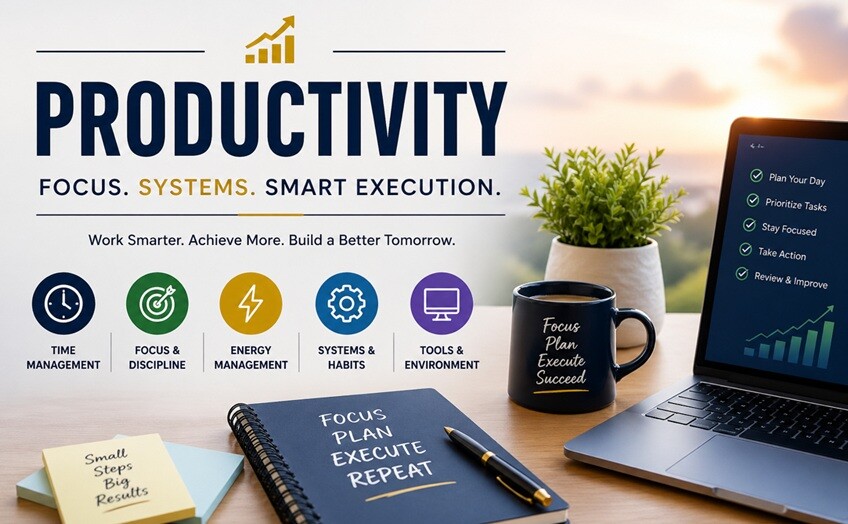
A sustainable productivity system rests on five connected areas:
- Time management
- Focus
- Energy management
- Systems and habits
- Tools and environment
1. Time Management: Control Your Day
Time is limited. Everyone has the same basic number of hours available each day, but people use those hours very differently.
Effective time management begins by deciding where your time should go before other demands take control of it.
Key Principles of Time Management
Prioritize Important Work
Not every task deserves equal attention.
Separate tasks according to their importance and potential impact.
Ask:
- Does this task contribute to an important goal?
- Does it have a meaningful deadline?
- Can someone else handle it?
- What happens if I don’t do it?
Plan Your Day
Start your day with a short plan.
Identify your most important tasks and decide when you will work on them.
A simple approach is to select your Top 3 priorities for the day.
Use Time Blocking
Instead of keeping your entire day open, assign specific periods to important activities.
For example:
- 9:00–10:30 — High-focus project
- 10:30–11:00 — Email
- 11:00–12:00 — Meetings
- 2:00–3:00 — Project execution
- 4:00–4:30 — Administrative work
Time blocking creates boundaries around your attention.
Leave Buffer Time
Don’t schedule every minute.
Unexpected calls, questions, technical problems, and urgent tasks will appear.
A realistic schedule includes space for them.
For additional ideas, see Time Tracking Software: The Path to Greater Productivity.
2. Focus: The Power of Deep Work
Time alone does not produce results.
You also need attention.
Focus is the ability to concentrate on an important task without repeatedly switching to unrelated activities.
Why Focus Matters
Every interruption creates a cost.
Constantly checking email, notifications, messages, social media, and unrelated tasks can make important work take much longer.
Focused work allows you to dedicate sustained attention to tasks that require thinking, creativity, analysis, or problem-solving.
How to Improve Focus
Start with simple changes:
- Turn off unnecessary notifications
- Keep your phone away during focused work
- Close irrelevant browser tabs
- Avoid unnecessary multitasking
- Use dedicated work sessions
- Tell colleagues when you need uninterrupted time
- Keep your workspace organized
Use Deep-Work Sessions
For demanding tasks, create an uninterrupted work period.
A 60–90 minute session can be useful for work requiring sustained concentration, although the ideal duration depends on the person and task.
During the session:
- Choose one important task.
- Define the desired outcome.
- Remove obvious distractions.
- Work continuously.
- Take a break afterward.
The goal isn’t to work intensely all day. It is to protect periods of high-quality attention.
3. Energy Management: Work With Your Energy
Time management is important, but time isn’t the only resource you need to manage.
Your physical and mental energy also affect how effectively you work.
Three Types of Energy
Physical Energy
Your physical state can influence your ability to concentrate and sustain effort.
Regular movement, adequate rest, hydration, and healthy routines can support productive work.
Mental Energy
Complex thinking requires mental effort.
Avoid filling your highest-energy periods with low-value administrative tasks when possible.
Emotional Energy
Stress, conflict, uncertainty, and constant interruptions can consume attention.
Creating a calmer working environment can make it easier to concentrate.
Identify Your Peak Hours
Notice when you naturally perform your best.
Are you most alert in the morning? Do you think more clearly in the afternoon?
Once you understand your pattern, schedule demanding work during your strongest periods when practical.
4. Systems and Habits: The Foundation of Consistency
Motivation can help you start.
Systems help you continue.
A productivity system is a repeatable process that makes it easier to complete important work consistently.
Why Systems Matter
Good systems can:
- Reduce decision fatigue
- Create consistency
- Make priorities visible
- Reduce forgotten tasks
- Simplify recurring activities
- Make progress easier to measure
Build Small Habits
Don’t try to completely redesign your life overnight.
Start with small habits such as:
- Planning tomorrow before finishing today
- Identifying three priorities each morning
- Reviewing your task list at lunch
- Scheduling focused work
- Reviewing your week every Friday
Small habits become powerful when repeated consistently.
Example Daily System
Plan → Focus → Execute → Review
Plan: Identify your priorities.
Focus: Work on the most important task without unnecessary distractions.
Execute: Complete the task and move to the next priority.
Review: Check what was completed and prepare for the next day.
5. Tools and Environment: Optimize Your Workflow
Technology can improve productivity, but more technology does not automatically mean greater productivity.
The best tool is the one that solves a real problem without creating unnecessary complexity.
Task Management Tools
Useful for:
- Tracking commitments
- Managing projects
- Recording deadlines
- Organizing tasks
See also: Top Five Task Management Tools to Boost Overall Productivity.
Calendar and Scheduling Tools
Useful for:
- Appointments
- Time blocking
- Meetings
- Protected focus periods
Note-Taking Tools
Useful for:
- Capturing ideas
- Recording information
- Creating reference material
- Organizing notes
Automation Tools
Useful when a task is:
- Repetitive
- Rule-based
- Time-consuming
- Performed frequently
Before automating something, first ask whether the task needs to exist at all.
Optimize Your Environment
Your physical and digital environments influence your ability to focus.
Consider:
- Keeping your desk organized
- Removing unnecessary notifications
- Closing unused applications
- Using a comfortable workspace
- Keeping frequently used information accessible
- Separating focused work from communication where possible
For more on the role of technology in productivity, read Digital Tools and Their Impact on Productivity at Work.
The InPeaks P.E.A.K. Productivity Framework
To bring these ideas together, InPeaks uses the P.E.A.K. Productivity Framework.
P — Prioritize What Matters
Productivity begins with priorities.
Identify the work that creates the greatest impact rather than automatically responding to whatever appears first.
Ask:
If I could complete only three important things today, what would they be?
Those tasks should receive appropriate time and attention.
E — Eliminate Distractions
Not everything competing for your attention deserves it.
Reduce:
- Unnecessary notifications
- Excessive meetings
- Repeated task switching
- Low-value activities
- Unnecessary communication
Elimination is often more powerful than simply trying to work faster.
A — Act With Focus
Once you know what matters, give it your attention.
Choose one important task, define the desired outcome, and work without unnecessary interruptions.
K — Keep Improving Systems
No productivity system is perfect.
Review what works and what doesn’t.
Ask:
- Where am I losing time?
- What tasks are repeatedly delayed?
- What can be simplified?
- What can be delegated?
- What can be automated?
- Which habits are helping?
- Which activities should be removed?
This creates a continuous improvement cycle.
A Simple Productivity System You Can Start Today
You don’t need a complicated productivity application or an elaborate routine.
Start with this simple system.
Step 1: Choose Your Top Three Priorities
At the beginning of the day, identify three tasks that would make the biggest difference if completed.
Step 2: Assign Time
Put those tasks into your calendar.
Don’t simply write them on a task list. Give important work a specific place in your day.
Step 3: Protect Your Focus
During the scheduled period:
- Silence unnecessary notifications
- Close unrelated applications
- Put your phone away if appropriate
- Work on one priority
Step 4: Capture New Tasks
When a new task appears, don’t immediately abandon your current work.
Write it down and return to your priority unless the new task is genuinely urgent.
Step 5: Review at the End of the Day
Ask:
- What did I complete?
- What remains unfinished?
- Why was it delayed?
- What should I change tomorrow?
This five-step process can become the foundation of your personal productivity system.
Step-by-Step Productivity Roadmap
Step 1: Identify Your Priorities
List your current responsibilities and determine which ones have the greatest impact.
Step 2: Plan Your Day
Choose your top priorities and allocate time for them.
Step 3: Protect Focus
Create uninterrupted periods for important work.
Step 4: Build Consistent Habits
Turn useful actions into repeatable routines.
Step 5: Reduce Low-Value Work
Look for tasks that can be eliminated, simplified, delegated, or automated.
Step 6: Use Tools Carefully
Choose tools based on actual needs rather than collecting applications.
Step 7: Review Your Performance
At the end of each week, evaluate what worked and what didn’t.
Step 8: Improve Your System
Make one or two meaningful changes rather than constantly changing everything.
Common Productivity Mistakes Professionals Must Avoid
Mistake 1: Confusing Busyness With Productivity
A full schedule doesn’t necessarily mean meaningful progress.
Fix: Measure outcomes rather than the number of tasks completed.
Mistake 2: Multitasking
Constantly switching between tasks can make focused work more difficult.
Fix: Work on one meaningful task at a time whenever practical.
Mistake 3: Starting Without Priorities
If everything is treated as equally important, your attention becomes fragmented.
Fix: Identify your most important tasks before beginning the day.
Mistake 4: Overloading Your Schedule
A schedule filled from morning to evening leaves no room for unexpected work.
Fix: Build realistic schedules with buffer time.
Mistake 5: Ignoring Breaks
Working continuously isn’t always the most effective way to sustain performance.
Fix: Use planned breaks and alternate periods of concentration with recovery.
Mistake 6: Depending Entirely on Motivation
Motivation naturally fluctuates.
Fix: Build systems that make the desired behavior easier to repeat.
Mistake 7: Using Too Many Productivity Tools
More applications can create more administration.
Fix: Use the minimum number of tools necessary to manage your workflow effectively.
Mistake 8: Constantly Changing Systems
Changing your productivity method every few days prevents you from discovering whether a system actually works.
Fix: Give a practical system enough time to evaluate it before making major changes.
Productivity Tools, Frameworks, and Strategies
Eisenhower Matrix
Categorize tasks according to importance and urgency:
- Important and urgent
- Important but not urgent
- Not important but urgent
- Not important and not urgent
The framework can help you distinguish genuinely important work from activity that simply feels urgent.
80/20 Principle
The 80/20 principle encourages you to identify the relatively small number of activities that produce a large proportion of your results.
Ask:
Which activities create the greatest value?
Then protect time for them.
Pomodoro Technique
The Pomodoro approach divides work into focused intervals separated by short breaks.
It can be useful when:
- A task feels difficult to start
- You struggle with sustained attention
- You want a defined work period
Time Blocking
Time blocking assigns specific periods to specific activities.
It is particularly useful for people whose days are frequently interrupted.
Task Batching
Group similar tasks together.
For example:
- Email together
- Administrative work together
- Calls together
- Content work together
This can reduce unnecessary context switching.
Real-World Productivity Scenarios
Scenario 1: The Overwhelmed Professional
A professional has dozens of tasks and doesn’t know where to start.
Solution:
- Identify the most important priorities
- Separate urgent work from important work
- Schedule focused work
- Remove low-value activities
- Review progress at the end of the day
Result: The workload becomes more manageable and important work receives greater attention.
Scenario 2: The Distracted Worker
Another professional constantly checks email, messages, notifications, and social media.
Solution:
- Turn off unnecessary notifications
- Schedule specific communication periods
- Create focused work sessions
- Keep distracting applications closed
Result: They spend more time on meaningful work and less time switching between activities.
Scenario 3: The High Performer
A high-performing professional doesn’t simply work longer.
Instead, they:
- Plan priorities
- Protect focus
- Use repeatable systems
- Delegate where appropriate
- Automate repetitive work
- Review their performance
Result: They can maintain more consistent performance while using their time more deliberately.
Productivity by Career Stage
Early Career: 0–5 Years
The priority should be building strong foundations.
Focus on:
- Time management
- Professional habits
- Learning to prioritize
- Meeting deadlines
- Developing discipline
- Reducing distractions
- Building reliable work routines
Early in your career, productivity is largely about learning how to manage yourself effectively.
Mid-Career: 5–15 Years
Your responsibilities often become more complex.
Focus on:
- Delegation
- Strategic prioritization
- Meeting management
- Workflow improvement
- Automation
- Managing multiple responsibilities
- Protecting time for important work
At this stage, productivity becomes less about personally completing everything and more about creating leverage.
Senior Career: 15+ Years
Senior professionals should focus increasingly on impact rather than activity.
Focus on:
- Strategic decisions
- Delegation
- Leadership
- High-impact priorities
- Developing others
- Reducing unnecessary work
- Creating systems that scale
The question shifts from:
“How much can I accomplish myself?”
to:
“Where can my time and decisions create the greatest impact?”
Advanced Productivity Strategies
Choose Strategic Work Over Reactive Work
Reactive work constantly responds to whatever appears next.
Strategic work begins with predetermined priorities.
Reserve time for important work before your schedule becomes dominated by interruptions.
Use Energy-Based Scheduling
Don’t treat every hour as equally productive.
Schedule demanding work when your energy and concentration are strongest.
Automate Repetitive Work
Look for recurring processes that can be automated.
Examples include:
- Repetitive data entry
- Routine notifications
- Report generation
- File organization
- Recurring administrative processes
Automation should reduce work rather than create another complicated system to manage.
Improve Your Working Environment
Your environment should make productive behavior easier.
Reduce visual and digital clutter, organize frequently used resources, and make distractions less accessible.
For more ideas, see 5 Effective Office Design Tips to Boost Employee Productivity.
Create Decision Rules
Simple rules can reduce repeated decision-making.
For example:
- Check email at specific times.
- Review tasks before accepting new commitments.
- Schedule important work before optional work.
- Review unfinished tasks at the end of each day.
These rules reduce the number of decisions you need to make repeatedly.
A Practical Weekly Productivity System
Daily productivity works better when supported by a weekly review.
Weekly Planning
At the beginning or end of the week:
- Review your major responsibilities.
- Identify important goals.
- List major deadlines.
- Select your highest-impact priorities.
- Allocate time for important work.
- Identify potential obstacles.
Daily Execution
Each day:
- Review your priorities
- Choose your top three tasks
- Protect focused work
- Handle communication in designated periods
- Capture new tasks without immediately switching
- Review your progress
Weekly Review
At the end of the week, ask:
What worked?
Identify the habits and systems that helped.
What didn’t work?
Look for recurring obstacles.
Where did I lose time?
Identify unnecessary meetings, interruptions, administrative work, or poor planning.
What should I change?
Choose one or two improvements for the following week.
This creates a continuous Plan → Focus → Execute → Review → Improve cycle.
Productivity and Technology
Technology can be both a productivity accelerator and a distraction.
The difference depends on how you use it.
Use digital tools to:
- Organize information
- Automate repetitive processes
- Schedule work
- Track projects
- Communicate efficiently
- Analyze performance
But don’t allow tools to become another source of constant interruption.
A useful principle is:
Technology should support your productivity system, not become your productivity system.
The system comes first.
The tools come second.
Productivity and Career Growth
Productivity becomes especially valuable when connected to professional development.
Instead of using all available time simply to complete today’s tasks, protect some time for future growth.
Use your productivity system to make room for:
- Learning new skills
- Reading
- Professional networking
- Career planning
- Building projects
- Improving communication
- Developing leadership skills
This is where productivity connects directly with career growth.
The goal isn’t simply to finish today’s workload.
It is also to create enough capacity to prepare for tomorrow’s opportunities.
Further Productivity Resources
Continue exploring practical productivity topics on InPeaks:
- Time Tracking Software: The Path to Greater Productivity
- 5 Effective Office Design Tips to Boost Employee Productivity
- Top Five Task Management Tools to Boost Overall Productivity
- Digital Tools and Their Impact on Your Productivity at Work
- Tips for Maintaining Productivity and Managing Stress During Work From Home
- Top Future Trends in Performance Management
Frequently Asked Questions About Productivity
What is productivity?
Productivity is the ability to produce meaningful results through the effective use of time, attention, energy, and resources.
How can I improve my productivity?
Start by identifying your highest-impact priorities, scheduling focused work, reducing distractions, building consistent habits, and reviewing your results regularly.
What is the best productivity method?
There is no single method that works for everyone. Time blocking, prioritization, focused work sessions, task batching, and weekly reviews can all be useful depending on your responsibilities and working style.
How do I stay focused while working?
Remove unnecessary distractions, choose one important task, define the desired outcome, and work for a dedicated period without unnecessary interruptions.
Should I use productivity apps?
Use them when they solve a genuine problem. A simple system that you consistently use is generally more valuable than a complex collection of applications.
How do I avoid feeling overwhelmed by my workload?
Start by identifying what matters most. Break large projects into smaller steps, remove or delegate lower-value work where possible, and create a realistic schedule with some buffer time.
Is multitasking productive?
Constantly switching between unrelated tasks can make focused work more difficult. For demanding tasks, concentrating on one activity at a time is generally a better approach.
How can productivity help my career?
Better productivity can help you complete important work consistently, create capacity for learning, manage responsibilities, and demonstrate reliability and impact.
How often should I review my productivity system?
A short daily review can help you adjust priorities, while a weekly review gives you enough perspective to identify recurring problems and improve your system.
Conclusion: Work Smarter, Achieve More
Productivity is not about filling every hour with work.
It is about making better choices about where your time, attention, energy, and effort should go.
The most sustainable productivity systems combine:
- Clear priorities
- Focused execution
- Effective time management
- Energy management
- Consistent habits
- Simple systems
- Useful technology
- Regular review and improvement
The InPeaks P.E.A.K. framework brings these ideas together:
P — Prioritize What Matters
E — Eliminate Distractions
A — Act With Focus
K — Keep Improving Systems
You don’t need to transform your entire routine at once.
Start with one priority.
Protect one focused work session.
Build one useful habit.
Remove one unnecessary distraction.
Then review and improve.
Over time, these small changes can create a productivity system that helps you work more effectively, develop professionally, and achieve meaningful results without simply working longer hours.
Continue Your Productivity Journey
This guide is the cornerstone of the InPeaks Productivity topic.
For more practical strategies, tools, and workflows, continue to the Productivity Hub: Focus, Systems and Performance for Getting More Done.
Start small. Focus on what matters. Build systems that work. Keep improving.