It’s 11:40 pm. A customer types, “Where is my refund?” into your website chat. The bot answers, “I’m sorry, I didn’t catch that.” She tries again and gets the same reply. Then she closes the tab and leaves a one-star review.
Almost every business that adds a chatbot hits a moment like this eventually. And it usually traces back to one early decision: did we buy a ready-made tool, or did we build something around how our business actually works?
Neither choice is automatically right. A ready-made chatbot can be live by Friday. A custom AI chatbot can handle jobs that a template never will. This guide explains the real trade-offs in plain language, so you can choose what fits your situation rather than a vendor’s pitch.
Difference Between Custom and Off-the-shelf AI Chatbots?
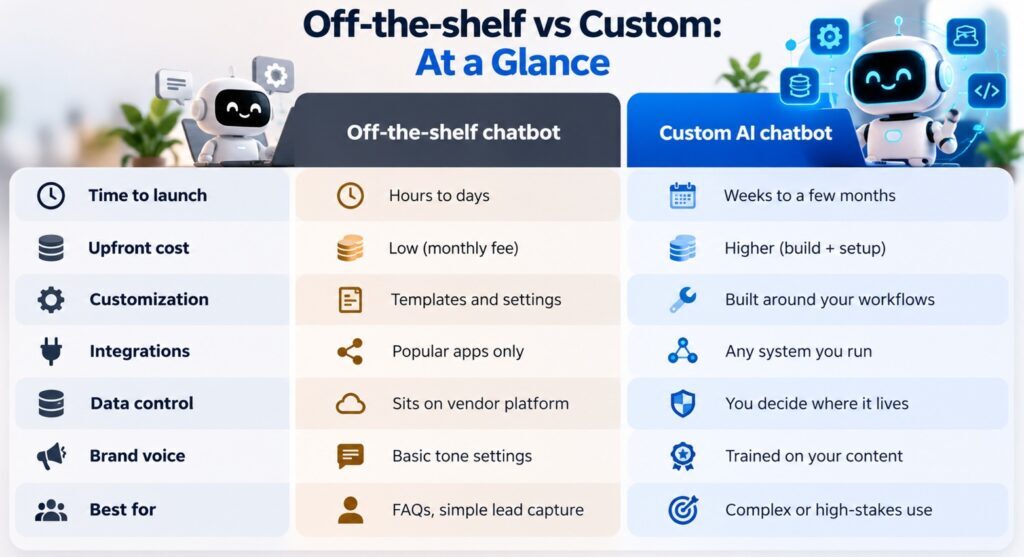
An off-the-shelf chatbot is a finished product. You sign up, upload your FAQs, paste a snippet onto your website, and you’re live. Popular platforms such as IBM watsonx Assistant, Google Dialogflow CX, and Chatfuel work this way. Think of it as renting a furnished flat: quick to move in, but you can’t knock down walls.
Custom AI chatbot development means building the bot around your business. It learns from your own documents, connects to your own systems, follows your rules, and speaks in your brand voice. That’s closer to designing your own house: it takes longer, but every room is where you want it.
When is an Off-the-shelf Chatbot the Smarter Choice?
Let’s be fair: ready-made tools aren’t the “cheap option” you grow out of. For many teams, they’re exactly right. Go this route when:
- You need to launch fast. You can test the idea this week instead of this quarter.
- Your questions are simple. Opening hours, delivery policy, pricing pages, and basic lead capture.
- You only need standard integrations. Mainstream tools like Slack, Zendesk, or Salesforce are covered by built-in connectors.
- You’re still learning. A low-cost pilot shows you what customers really ask before you invest more.
The limits tend to show up around month three or four, which is where most teams start asking about custom options. The bot can’t see your order system, it gives generic answers about your products, or the monthly bill climbs as conversations grow.
Here’s the whole comparison in one view before we go further:
Five Signs you’ve Outgrown a Ready-made Bot
If several of these sound familiar, it’s worth looking at custom AI chatbot development seriously.
- It has to act, not just answer. Checking an order, rebooking an appointment, or updating a CRM record all need deep integration with your systems.
- Your business has its own language. Product codes, internal policies, and industry jargon trip up generic bots, which then give vague or wrong answers.
- Your data is sensitive. In healthcare, finance, legal, or government work, you may need to control exactly where data is stored, encrypted, and audited.
- Customers expect personalization. A bot that remembers context and doesn’t make people repeat themselves feels noticeably better than one that starts from scratch every time.
- Volume is growing. When conversation counts rise, predictable running costs start to matter more than a low entry price.
This is the territory of the enterprise AI chatbot. It doesn’t just chat. It looks things up, completes tasks, hands over to a person at the right moment, and shows you what’s working.
What’s Inside a Custom Chatbot?
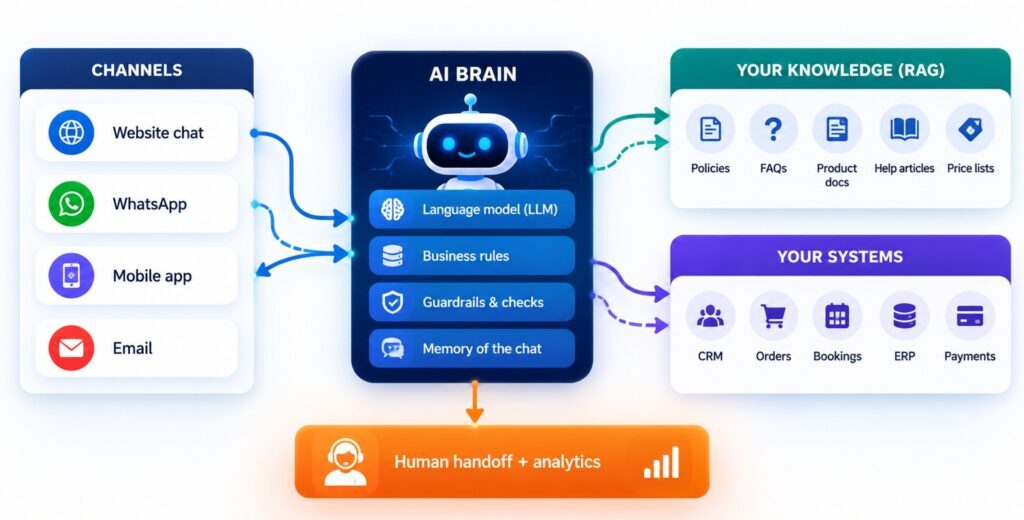
If you go custom, it helps to know the moving parts. A language model alone isn’t a chatbot. A production-ready one usually combines:
- A language model (LLM). The “brain” that understands and writes natural language. Connecting it properly to your product is the job of LLM integration.
- Your knowledge, via RAG. Retrieval-augmented generation lets the bot look up answers in your approved documents instead of guessing. RAG development is a big reason custom bots stay accurate and current.
- Integrations. Links to your CRM, ERP, payments, and booking tools so the bot can complete tasks.
- Guardrails. Rules about what the bot may say, which sources it may use, and when it must stop and ask a person.
- Handoff and analytics. A smooth path to a human, plus reports that show what customers ask and where the bot struggles.
The newest step up is the AI agent: a bot that doesn’t only reply but carries out multi-step work on your behalf. If that’s where you’re heading, look at what AI agent development involves before you pick a platform, because some ready-made tools can’t grow in that direction.
Let’s talk about cost, without the sales pitch
On day one, a subscription tool almost always looks cheaper. A custom build asks for more upfront (design, development, integrations, and testing). But the picture changes over time, because subscriptions often rise with conversations, seats and add-on features, while a custom bot’s running costs (hosting, model usage, maintenance) tend to be steadier.
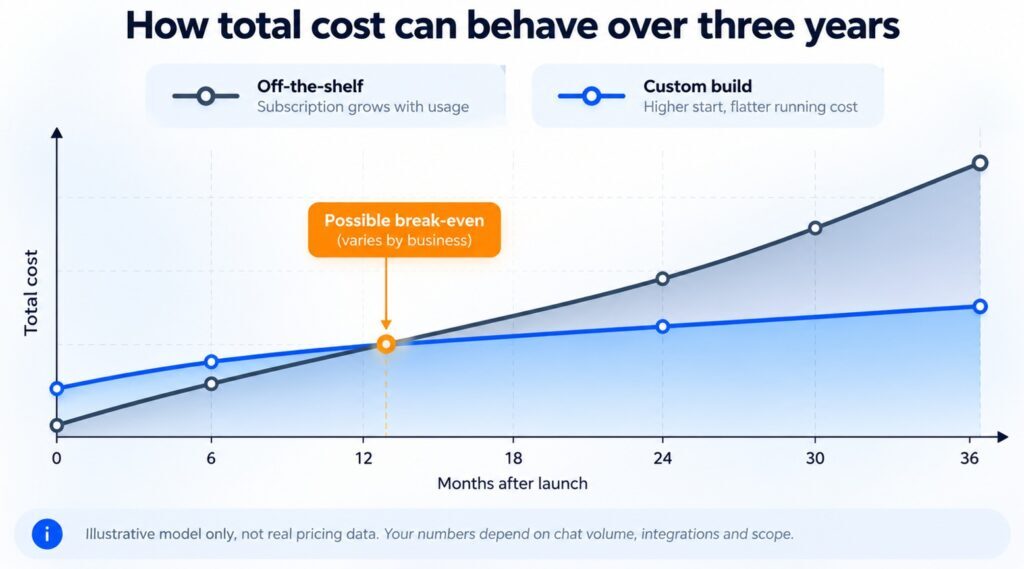
Figure 3: Illustrative only. Your break-even point depends on volume, scope, and integrations.
So “which is cheaper?” is the wrong question. Ask instead, which one delivers more value for the money over two or three years? Measure that with a handful of numbers:
- Deflection rate: how many questions are fully resolved without a person.
- Resolution time: how quickly customers get a correct answer.
- Customer satisfaction (CSAT): whether people feel better served.
- Agent time saved: hours your team gets back for harder work.
- Conversions: for sales bots, whether more chats become purchases.
The Risk People Forget: You Own What Your Chatbot Says
In 2024, a Canadian tribunal ruled that Air Canada was responsible for wrong refund information its website chatbot gave a customer, rejecting the argument that the bot was a separate entity. The American Bar Association’s summary of the case notes that the airline was held liable for what appeared on its website, whether it came from a static page or a chatbot. The amount was small. The lesson wasn’t: your chatbot speaks for your company.
Customer trust is part of this too. A Gartner survey of 5,728 customers, reported by Call Centre Helper, found that 64% would prefer companies not use AI in customer service, with the biggest worry being that it makes reaching a real person harder. That doesn’t mean “skip the chatbot”. It means design it well and always give people an easy way to reach a human.
| Worth remembering: With a custom build, you decide which sources the bot may use, what it must never say, and how answers are checked. With a ready-made tool, you rely largely on the vendor’s controls. It’s also worth reading the OWASP Top 10 for LLM Applications for risks such as prompt injection and data leakage, then asking any vendor how they handle them. |
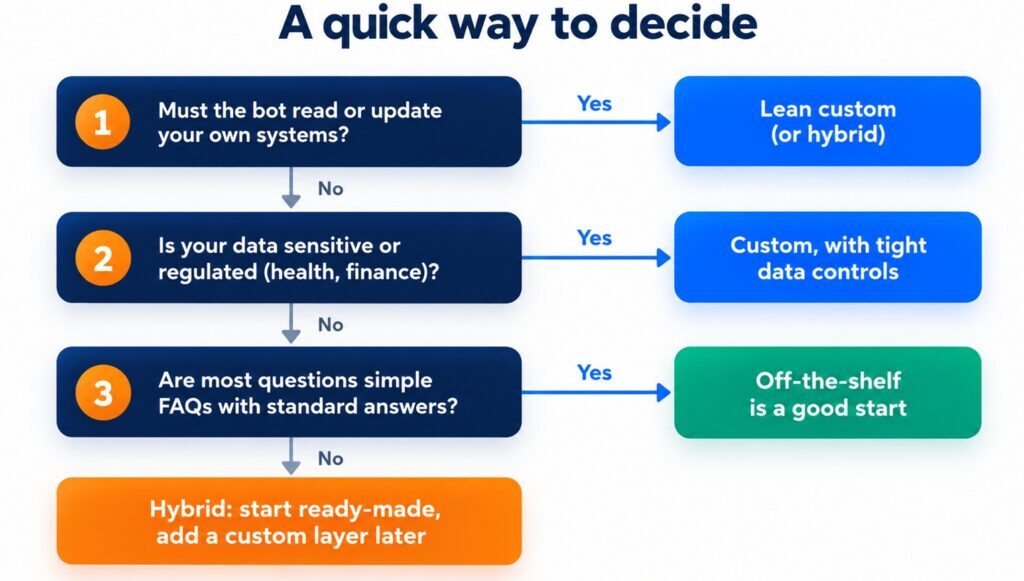
A quick way to decide
If you’re still on the fence, run through these three questions.
How to Choose an AI Chatbot Development Company?
If custom looks right, the partner matters as much as the idea. Before you sign, ask whether they can:
- Show you working chatbots they’ve built, not just slides.
- Connect to your CRM, ERP, or booking systems.
- Explain how they test for accuracy and stop wrong answers.
- Describe how they handle security, privacy, and access controls.
- Make sure you own the code, prompts, and data.
- Support the bot after launch with monitoring and updates.
A good partner will also tell you when an off-the-shelf tool is enough. Be wary of anyone who only sells one option.
Final Thoughts
Off-the-shelf chatbots are fast and affordable, and they’re a perfectly sensible first step. Custom AI chatbot development gives you control, accuracy, and room to grow when the bot has to do real work inside your business. The right answer depends on what the chatbot must do, how sensitive your data is, and how much you expect to scale.
If you’re unsure, start small, learn from real conversations, and upgrade when the need is clear. Whichever way you go, remember that your chatbot is often the first “person” a customer meets.
FAQs
1. What is the main difference between a custom and an off-the-shelf AI chatbot?
Answer: An off-the-shelf chatbot is a ready-made product you configure with your content. A custom AI chatbot is built for your business, using your data, systems, rules, and brand voice.
2. When should a business choose custom AI chatbot development?
Answer: Choose custom when the bot must connect deeply to your systems, handle sensitive or regulated data, follow unique workflows, or scale to high conversation volumes.
3. Is an off-the-shelf chatbot good enough for a small business?
Answer: Often, yes. If you need simple FAQ answers and lead capture without deep integrations, a ready-made tool is quick and affordable. You can always add a custom layer later.
4. Is my company responsible for what its chatbot says?
Answer: In general, yes. In the 2024 Moffatt v. Air Canada decision, a tribunal held the airline responsible for incorrect information its chatbot gave a customer. Get legal advice for your own situation.
5. How long does it take to build a custom chatbot?
Answer: It depends on scope, integrations, and data readiness. Many teams begin with a focused proof of concept over a few weeks, then expand once it proves its value.
You may also like to read,
- How to Build and Train Deep Learning Chatbots for Better Customer Interaction
- Empowering Businesses with AI: Custom Chatbot Development Services
- E-commerce Chatbot: Boosting Conversions and Sales in 2026