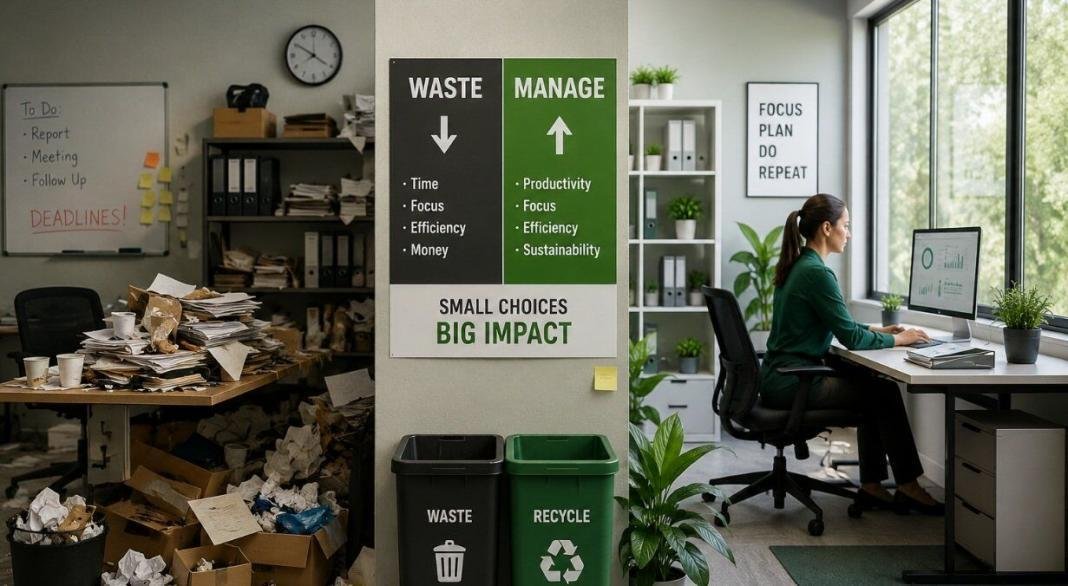
In terms of business productivity, organizations always consider obvious elements like software lag, unnecessary meetings, ineffective communications, or processes. However, the physical environment never attracts enough attention.
However, the office environment may contribute to the creation of productivity issues in an inconspicuous way. Cluttered spaces, excessive amounts of garbage, as well as inefficient waste management systems, may be distracting from smooth workflow without being noticed. The problem is not even about having the garbage in place. The problem is about having to deal with it within the working process.
When Rubbish Becomes an Operational Problem
Waste becomes an operational issue even before a workplace looks dirty. For instance, a collection of waste material on an access point makes employees use longer routes from one workstation to another.
During a construction project, employees are forced to take breaks in order to clear waste like packaging or damaged materials away. Such interruptions may last just a few minutes; however, they can repeat throughout the project.
The issue of dispersed waste also needs to be mentioned. In cases where there is no place to dispose of waste, this material tends to gather at the workstations. At some point, someone will have to gather, dispose and organize it, spending time that could be used for their main tasks.
So the hidden cost is not just disposal of waste material, but rather the process of disposal itself.
Small Delays Can Become a Bigger Productivity Loss
Ten minutes of disruption doesn’t seem like something to take seriously. However, the impact of lack of efficiency typically happens gradually rather than as a result of one significant incident.
Consider multiple workers who spend their time every day searching for a place to put waste materials. Although individually those few minutes aren’t a big deal, in aggregate they are moments of time which could be spent productively.
This is why minor inefficiencies should never be disregarded. Companies tend to be looking for radical changes without paying attention to minor inconveniences happening daily.
The point here is not about the actual monetary cost of each item of trash. The point is about understanding that all those movements and disruptions can be considered as sources of friction.
Waste Planning Is Really Workflow Planning
Proper waste management is best done well before the accumulation of refuse occurs.
It would be wise for companies not to wait until the working area is overcrowded with waste material and only then plan its removal but to incorporate proper waste management procedures into the workflow itself, considering what kinds of waste products are expected and how often they have to be collected.
For example, waste that comes from a renovation process will differ significantly from waste that results from finishing works. The construction works can also pass through several different stages, each producing some specific materials.
It is easier to organize such an operation and to ensure that active areas remain functional while making sure that workers know where the materials that are to be disposed of must go.
The same approach can be used even outside the context of construction. An office, a warehouse, workshop or any other business facility can also benefit from incorporating waste management into their workflow.
Waste management becomes much more efficient when done in the course of workflow design than as an additional procedure performed afterward.
The Right Setup Can Remove Unnecessary Movement
One practical way to reduce waste-related disruption is to provide a suitable collection point close enough to the work area to be convenient without creating an obstruction.
For projects generating significant amounts of rubbish, a skip bin can provide a defined location for collecting waste as work progresses. Instead of allowing discarded materials to spread across an area or relying on repeated trips to smaller bins, workers have a central place for appropriate waste.
The important factor is not simply having a bin. Its size, placement, access and collection schedule should make sense for the project.
For businesses and project managers operating locally, Darwin skip bin services can be one option to consider when planning waste removal alongside a project schedule. The objective is to make disposal fit naturally into the workflow rather than allowing it to become another interruption.
A Simple Productivity Audit Anyone Can Try
Improving workplace productivity does not always require expensive software or a complicated management system. A simple waste audit can reveal where avoidable friction exists.
Start by asking a few practical questions:
- Where does waste accumulate first?
Identify the areas where discarded materials regularly begin to build up. - How often is waste moved unnecessarily?
Look for repeated trips that could potentially be reduced through better placement or planning. - Are employees leaving their main task to deal with rubbish?
If workers regularly stop productive work to clear waste, the process may need adjustment. - Is the current collection method suitable for the volume of waste?
An undersized or poorly positioned container can create unnecessary handling. - Could collection timing be improved?
Waste removal that does not match the pace of a project can create congestion at inconvenient times. - Are different materials being handled appropriately?
Where relevant, separating recyclable, reusable and general waste can make the overall process more organised.
These questions take little time to answer, but they can reveal problems that are otherwise easy to ignore.
Remove Friction, Don’t Just Add Speed
Productivity is frequently defined as doing things more efficiently – completing more in less time. However, boosting productivity does not necessarily mean that people should do things faster. In some cases, it means getting rid of those elements that consistently make people slower in accomplishing their tasks.
For instance, waste management is one of the issues. Just a few minutes required to throw away some garbage may appear insignificant; however, when these interruptions become a common feature of a working environment, this problem can become an element of daily workplace friction.
Optimization of waste management can help ensure the workplace remains functional, cutting off unnecessary moves, and offering staff members a process for waste disposal.
Generally speaking, this approach can be used to a greater extent than waste management optimization. Instead of trying to make people do things faster, one should focus on what makes their work difficult.
You may also like to read,
- How to Reduce Waste in Your Business and Improve Environmental Sustainability
- How to Recycle Food Waste Without a Backyard Using Modern Composting Machines and Collection Services