Two professionals can have similar skills, experience, and opportunities yet achieve very different results.
One continues learning, adapts to change, takes action, and grows through challenges. Another may hesitate, avoid difficult situations, or become discouraged after setbacks.
One important difference can be the way they think about challenges, abilities, failure, and growth.
That is where mindset matters.
Your mindset influences how you interpret situations, how you respond to difficulties, how willing you are to learn, and how consistently you take action.
In a rapidly changing professional world, skills and knowledge are important, but your ability to learn, adapt, recover, and keep improving is equally valuable.
This guide will help you:
- Understand what mindset means in a modern context
- Develop a growth-oriented mindset
- Build resilience when facing setbacks
- Improve adaptability in a changing world
- Strengthen focus and discipline
- Develop healthy self-belief and confidence
- Apply mindset principles to career growth and productivity
- Create a practical system for continuous improvement
This guide is part of the comprehensive InPeaks Mindset Hub, where you can explore additional resources on growth, resilience, focus, confidence, and personal development.
What Is Mindset in the Modern World?
Mindset is the collection of beliefs, attitudes, assumptions, and mental frameworks that influence how you think, act, and respond to situations.
Your mindset can influence:
- How you interpret challenges
- How you approach opportunities
- How you respond to setbacks
- How you receive feedback
- How willing you are to learn
- How you define success
- How consistently you take action
A useful way to understand mindset is:
Your mindset is the lens through which you see and respond to the world.
Mindset is not simply about being positive all the time. A strong mindset also involves recognizing difficulties realistically, learning from experience, managing your response, and choosing constructive action.
Fixed Mindset
A fixed mindset assumes that abilities are largely fixed and cannot change significantly.
This can lead people to avoid challenges because failure may feel like evidence that they are not capable.
Growth Mindset
A growth mindset views abilities as capable of development through learning, effort, practice, feedback, and persistence.
Instead of asking, “Am I naturally good at this?”, a growth-oriented person is more likely to ask, “What can I learn and improve?”
This distinction can change how you approach difficult tasks, feedback, mistakes, and new opportunities.
Why Mindset Matters in Career Growth, Productivity, and Life
Mindset Influences Action
Your beliefs can influence the actions you are willing to take.
If you believe improvement is possible, you are more likely to experiment, practice, seek feedback, and try again.
If you believe your abilities cannot change, challenges may be more likely to feel threatening or discouraging.
Mindset Supports Resilience
Challenges and setbacks are part of professional and personal life.
A resilient mindset helps you:
- Recover from setbacks
- Learn from mistakes
- Look for solutions
- Maintain perspective
- Continue moving forward
Resilience does not mean ignoring disappointment. It means learning how to respond constructively when things do not go as planned.
Mindset Influences Productivity
Productivity depends on more than tools and task-management systems.
Your willingness to prioritize, focus, delay distractions, and consistently execute is also influenced by your mindset.
A useful productivity system becomes much more effective when supported by habits of discipline, reflection, and continuous improvement.
Mindset Shapes Career Growth
Professionals with a growth-oriented mindset are more willing to:
- Learn new skills
- Adapt to changing requirements
- Ask for feedback
- Take initiative
- Accept responsibility
- Experiment with new approaches
- Take on appropriate challenges
These behaviors can create more opportunities for professional development.
Mindset Influences Long-Term Success
Skills may help you enter a field, but continuous learning and adaptation help you remain effective as circumstances change.
A strong mindset therefore complements technical skills, professional experience, and practical knowledge.
The Core Pillars of a Powerful Mindset
A strong mindset can be developed through several interconnected capabilities:
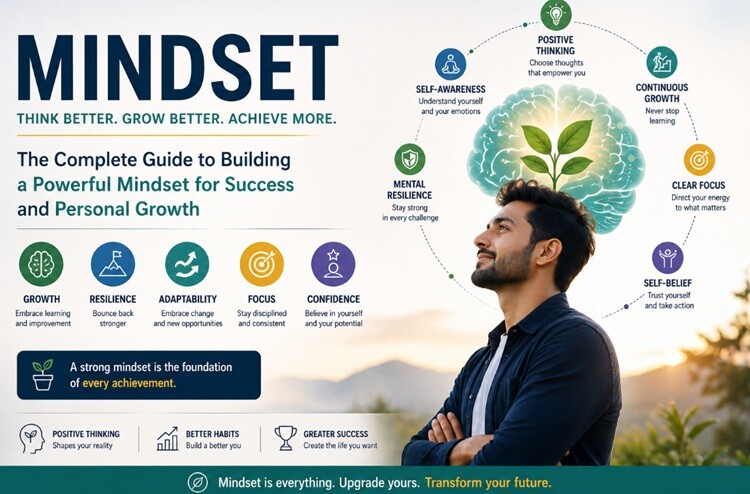
- Growth mindset
- Resilience
- Adaptability
- Focus and discipline
- Self-belief and confidence
1. Growth Mindset: The Foundation of Continuous Improvement
A growth mindset is the belief that abilities can develop through learning, effort, practice, feedback, and persistence.
Key Characteristics of a Growth Mindset
- Embraces appropriate challenges
- Views mistakes as opportunities to learn
- Seeks useful feedback
- Values progress
- Accepts that improvement takes time
- Continues learning when circumstances change
How to Develop a Growth Mindset
- Replace “I can’t” with “I can learn”
- Focus on progress rather than perfection
- Seek feedback regularly
- Study what went wrong after a setback
- Celebrate improvement rather than only final outcomes
- Take on challenges that stretch your abilities
Practical Example
Imagine you are asked to lead a project involving a skill you have never used before.
A fixed response might be:
“I don’t know how to do this, so I probably shouldn’t take it.”
A growth-oriented response might be:
“I haven’t done this before. What do I need to learn to handle it successfully?”
The second approach does not guarantee success, but it creates a stronger opportunity for learning and development.
2. Resilience: The Ability to Handle Setbacks
Resilience is the ability to respond to difficulties, recover, learn, and continue moving forward.
Every career involves setbacks such as:
- Rejection
- Failure
- Missed opportunities
- Unexpected changes
- Project problems
- Critical feedback
- Periods of uncertainty
Resilience does not mean that setbacks never affect you. It means developing the ability to respond without allowing one setback to define your entire direction.
How to Build Resilience
- Accept that setbacks are part of growth
- Focus on what you can control
- Separate facts from assumptions
- Look for lessons and solutions
- Maintain a long-term perspective
- Develop healthy routines that support consistency
Practical Example
A professional applies for several jobs but receives repeated rejections.
Instead of concluding that they are incapable, they can review their applications, interview performance, skills, and feedback to identify areas for improvement.
The setback becomes information that can guide the next attempt.
3. Adaptability: Thriving in a Changing World
Industries evolve. Technologies change. Job responsibilities shift. New tools and methods appear.
Adaptability is the ability to adjust your thinking and behavior when circumstances change.
Why Adaptability Matters
Professionals who remain willing to learn can respond more effectively when their roles, industries, or working environments change.
How to Build Adaptability
- Stay open to learning
- Experiment with new approaches
- Develop transferable skills
- Stay informed about relevant changes in your field
- Ask questions when expectations change
- View change as something to understand rather than automatically resist
Practical Example
A professional’s organization introduces new digital tools.
Instead of resisting the change immediately, they learn how the tools work, identify how they can improve their workflow, and help colleagues understand the new process.
Adaptability can therefore turn change into an opportunity to develop new capabilities.
4. Focus and Discipline: The Execution Advantage
Good ideas only create value when they are put into action.
Focus helps you direct your attention toward what matters. Discipline helps you continue taking appropriate action even when motivation fluctuates.
Key Components
- Clear priorities
- Consistent routines
- Ability to manage distractions
- Strong work habits
- Willingness to complete important tasks
How to Improve Focus and Discipline
- Set clear daily priorities
- Use time-blocking techniques
- Remove unnecessary distractions
- Work on one important task at a time when practical
- Build routines that reduce unnecessary decisions
- Review your progress regularly
For a deeper look at productivity, focus, and execution, see the Productivity: The Complete Guide to Achieving More with Focus, Systems, and Smart Execution.
5. Self-Belief and Confidence: The Internal Driver
Self-belief is confidence in your ability to learn, act, and handle challenges.
Healthy confidence does not mean believing you will always succeed. It means believing that you can take action, learn from experience, and improve.
Why Self-Belief Matters
Low confidence can cause people to:
- Hesitate to take action
- Avoid challenges
- Undervalue their abilities
- Miss opportunities
How to Build Confidence
- Track small wins
- Prepare thoroughly
- Take action despite reasonable fear
- Learn from previous successes
- Seek constructive feedback
- Surround yourself with supportive influences
Practical Example
A professional sees an opportunity for a higher-level role but does not meet every listed requirement.
Instead of automatically rejecting themselves, they can honestly assess their strengths, identify skill gaps, prepare for the role, and decide whether applying is appropriate.
Confidence is strengthened through preparation and action, not simply positive thinking.
The InPeaks Mindset Mastery Framework
To turn mindset principles into practical action, InPeaks uses the M.A.S.T.E.R. Model.
M — Mind Awareness
Understand your thoughts, assumptions, emotional reactions, and beliefs.
Before changing a pattern, you first need to recognize it.
Ask:
- What am I thinking?
- Why am I responding this way?
- What belief is influencing my decision?
A — Adapt Thinking
Identify limiting beliefs and replace unhelpful thinking with more constructive perspectives.
Instead of:
“I am not capable of this.”
Try:
“I don’t know this yet. What do I need to learn?”
S — Strengthen Discipline
Build routines that support your goals even when motivation is inconsistent.
Small repeated actions can be more useful than occasional bursts of enthusiasm.
T — Take Consistent Action
Mindset develops through action.
Don’t wait until you feel completely confident or motivated before starting.
Take the next appropriate step.
E — Embrace Challenges
Challenges can reveal areas where you need to learn and improve.
Instead of automatically avoiding difficulty, ask:
“What can this challenge teach me?”
R — Reflect and Improve
Regular reflection helps you identify patterns, recognize progress, and adjust your approach.
Ask:
- What worked?
- What didn’t work?
- What did I learn?
- What should I change next time?
Step-by-Step Mindset Development Roadmap
Step 1: Identify Limiting Beliefs
Recognize thoughts that repeatedly prevent you from taking useful action.
Examples include:
- “I am not good enough.”
- “I cannot do this.”
- “I always fail.”
- “It is too late for me to learn.”
Don’t automatically accept these statements as facts. Examine the evidence behind them.
Step 2: Replace Unhelpful Thinking
Reframe limiting thoughts into realistic, growth-oriented alternatives.
For example:
“I can’t do this.”
can become:
“I haven’t learned how to do this yet.”
Step 3: Build Daily Habits
Create routines that reinforce learning, reflection, focus, and action.
Examples include:
- Daily reflection
- Reading
- Learning a skill
- Planning priorities
- Recording progress
Step 4: Take Consistent Action
Action creates experience.
Experience provides feedback.
Feedback creates opportunities for improvement.
Don’t wait for perfect confidence before taking the next reasonable step.
Step 5: Reflect and Improve
Review your progress regularly.
Identify what worked, what did not work, and what you can change.
Common Mindset Mistakes Professionals Must Avoid
Fixed Thinking in a Dynamic World
Believing your abilities cannot develop can lead to avoidance and stagnation.
Fix:
- Reframe challenges as learning opportunities
- Track learning as well as outcomes
- Recognize improvement
Fear of Failure and Perfectionism
Waiting for the perfect moment can delay action and prevent learning.
Fix:
- Start with a realistic first step
- Set progress-based goals
- Use feedback to improve
- Accept that early attempts may not be perfect
Negative Self-Talk
Persistent negative internal dialogue can influence confidence and behavior.
Fix:
- Replace absolute statements with realistic ones
- Use evidence from previous accomplishments
- Focus on what you can control
- Practice constructive reframing
Comparing Your Journey to Others
Constant comparison can distract you from your own progress.
Fix:
- Focus on your own goals
- Define your version of success
- Measure progress against your previous performance
Inconsistency and Lack of Discipline
Motivation naturally changes. Systems and habits can provide greater consistency.
Fix:
- Build simple routines
- Track important habits
- Make useful behaviors easier to start
- Focus on consistency rather than perfection
Avoiding Discomfort
Learning often requires doing things that initially feel unfamiliar or difficult.
Fix:
- Take on manageable challenges
- Seek feedback
- Gradually expand your comfort zone
- Volunteer for appropriate learning opportunities
Tools, Frameworks, and Strategies for Mindset Improvement
A strong mindset is developed through repeated practice, reflection, and action rather than inspiration alone.
Practical Tools
- Journaling: Capture thoughts, reactions, challenges, and progress.
- Habit trackers: Make consistency visible.
- Accountability partners: Create additional commitment around important goals.
- Reflection prompts: Use regular questions to identify patterns and lessons.
Cognitive Reframing
Identify an unhelpful belief, examine it, and replace it with a more constructive and realistic interpretation.
For example:
Situation → Automatic thought → Evidence → Alternative interpretation → Action
WOOP Method
WOOP stands for:
- Wish: Define what you want.
- Outcome: Identify the positive result you want.
- Obstacle: Identify what could prevent progress.
- Plan: Create an “if-then” response.
Implementation Intentions
Create a simple rule connecting a situation with an action.
For example:
“If I become distracted during focused work, I will close the distracting application and return to my priority.”
Habit Loop
A habit can be understood through three elements:
Cue → Routine → Reward
Designing useful cues and routines can make positive behaviors easier to repeat.
Daily and Weekly Mindset System
Daily Mindset Practice: 10–20 Minutes
- 5 minutes: Identify your priorities and intention for the day.
- 10 minutes: Begin an important task with focused attention.
- 5 minutes: Reflect on what you accomplished and learned.
Weekly Mindset Review: 30–45 Minutes
- Review wins and setbacks
- Identify one recurring limiting belief
- Consider what you learned during the week
- Identify one behavior to improve
- Choose your focus areas for the following week
This creates a simple cycle:
Awareness → Reframe → Act → Reflect → Improve
Real-World Mindset Scenarios
Scenario 1: From Self-Doubt to Confidence
A professional avoids speaking in meetings because they are afraid of making mistakes.
Shift:
- Prepare one useful point before each meeting
- Make small contributions consistently
- Record successful contributions
- Ask for constructive feedback
Potential result:
- Greater confidence
- Improved visibility
- More willingness to participate
Scenario 2: Overcoming Failure
An employee repeatedly applies for promotions without success.
Shift:
- Seek specific feedback
- Identify missing skills
- Develop those skills
- Take responsibility for professional development
- Apply again when appropriate
Potential result:
- Improved performance
- Greater readiness for future opportunities
- Stronger understanding of personal development needs
Scenario 3: Adapting to Change
A team transitions to new digital tools.
Shift:
- Learn the tools proactively
- Experiment with practical uses
- Help colleagues when appropriate
- Share useful practices
Potential result:
- Greater adaptability
- Improved digital capability
- Greater contribution to the team
Mindset Across Career Stages
Early Career: 0–5 Years
Early in your career, focus on developing curiosity, learning habits, discipline, and confidence.
Focus on:
- Learning mindset
- Curiosity
- Experimentation
- Building discipline
- Accepting feedback
Key habit: Try, learn, improve, and repeat.
Mid-Career: 5–15 Years
As responsibilities increase, mindset should expand from personal execution toward strategic thinking and ownership.
Focus on:
- Strategic thinking
- Ownership
- Leadership mindset
- Resilience under pressure
- Adaptability
Key habit: Prioritize high-impact work and think beyond immediate tasks.
Senior Career: 15+ Years
At senior levels, mindset increasingly involves perspective, influence, mentorship, and long-term thinking.
Focus on:
- Influence
- Perspective
- Mentorship
- Long-term thinking
- Developing others
Key habit: Multiply your impact through people, decisions, and systems.
Advanced Mindset Strategies
Strategic Thinking Over Reactive Thinking
Reactive thinking focuses mainly on responding to whatever happens next.
Strategic thinking creates space to anticipate challenges and deliberately choose priorities.
Try to:
- Define longer-term priorities
- Anticipate potential obstacles
- Reserve time for strategic thinking
- Review whether daily activities support larger goals
Identity-Based Growth
Consider how you want to behave rather than focusing only on what you want to achieve.
Instead of saying:
“I want to become more productive.”
Consider:
“I am becoming a disciplined professional who consistently follows through on important commitments.”
The purpose is not to make unrealistic claims about yourself. It is to reinforce behaviors that support the identity you want to develop.
Energy Management
Mindset and performance are influenced by your ability to manage your attention and energy.
Consider:
- Protecting periods of focused work
- Taking appropriate breaks
- Matching demanding work with periods when you concentrate best
- Reducing unnecessary interruptions
Environment Design
Your environment can either support or undermine your intentions.
Design your surroundings to make useful behaviors easier.
- Remove unnecessary distractions
- Keep important tools accessible
- Create a dedicated focus area where possible
- Reduce digital interruptions
Mindset, Productivity, and Career Growth
Mindset should not exist in isolation.
A growth-oriented mindset supports your ability to learn new digital skills, improve productivity, and pursue meaningful career development.
These areas reinforce one another:
Mindset → Learning → Skills → Action → Results → Reflection → Growth
For example, learning a new professional skill requires a willingness to be a beginner. Applying that skill requires action. Improving it requires feedback. Continuing after mistakes requires resilience.
That is why mindset can serve as an important foundation for both career growth and productivity.
Further Mindset Resources
Continue exploring related mindset and personal-development resources on InPeaks:
- How AI Can Foster Deep Thinking in a Distracted World
- Breathing New Life Into a Stunted Career: Practical Ways to Regain Momentum
- Embracing HR Digital Transformation: The Power of Positive Change
- How to Generate Positive Thoughts to Improve Life
- How to Become a Successful Entrepreneur with Positive Thinking
- How to Start Your Morning Positively?
- Focus on the Positives: 3 Good Things to Come From the Isolation
- Harness the Power of Positive Thinking When Your Family Does Not Support You
Frequently Asked Questions About Mindset
What is mindset?
Mindset is the collection of beliefs, attitudes, assumptions, and mental frameworks that influence how you think, act, and respond to situations.
Why is mindset important for success?
Mindset can influence how you respond to challenges, whether you continue learning, how you handle setbacks, and how consistently you take action.
How can I develop a growth mindset?
Focus on learning, embrace appropriate challenges, seek useful feedback, learn from mistakes, and focus on progress rather than perfection.
What are common mindset mistakes?
Common patterns include fixed thinking, fear of failure, perfectionism, negative self-talk, excessive comparison, inconsistency, and avoiding challenges.
Can mindset be changed?
Mindset can develop over time through awareness, reflection, learning, repeated behaviors, and intentional practice.
How does mindset affect productivity?
Mindset can influence focus, discipline, consistency, and your willingness to follow through on important tasks.
What is the best daily habit for mindset improvement?
A simple combination of reflection and focused action can be useful. Identify your priorities, take meaningful action, and briefly review what you learned at the end of the day.
How can mindset help with career growth?
A growth-oriented mindset can encourage continuous learning, adaptability, initiative, resilience, and willingness to take on appropriate challenges.
How can I become more resilient?
Focus on what you can control, learn from setbacks, maintain perspective, seek constructive feedback, and continue taking appropriate action.
How can I become more confident?
Build confidence through preparation, small wins, deliberate practice, learning from experience, and taking action even when you do not feel completely confident.
Conclusion: Master Your Mindset to Unlock Your Potential
Your mindset influences how you interpret challenges, respond to setbacks, approach opportunities, and continue learning.
A powerful mindset does not mean believing that everything will always go well. It means developing the ability to respond constructively when things do not go as planned.
If you want to build a stronger mindset:
- Develop a growth-oriented perspective
- Strengthen resilience
- Stay adaptable
- Build focus and discipline
- Develop healthy self-belief
- Take consistent action
- Reflect and improve
You don’t need to change everything at once.
Start by becoming more aware of one limiting belief.
Reframe one unhelpful thought.
Take one meaningful action.
Reflect on what you learn.
Then repeat.
Over time, these small actions can create stronger patterns of thinking and behavior that support personal development, productivity, and career growth.
Your mindset does not determine every outcome, but it can strongly influence how you respond to the circumstances you face and what you do next.
Continue Your Mindset Development Journey
This guide is the cornerstone of the InPeaks Mindset topic.
Continue exploring practical strategies for growth, resilience, focus, confidence, and personal development in the Mindset Hub: Build Growth, Resilience & Success for Life and Career.
Build awareness. Reframe your thinking. Take action. Reflect. Keep growing.