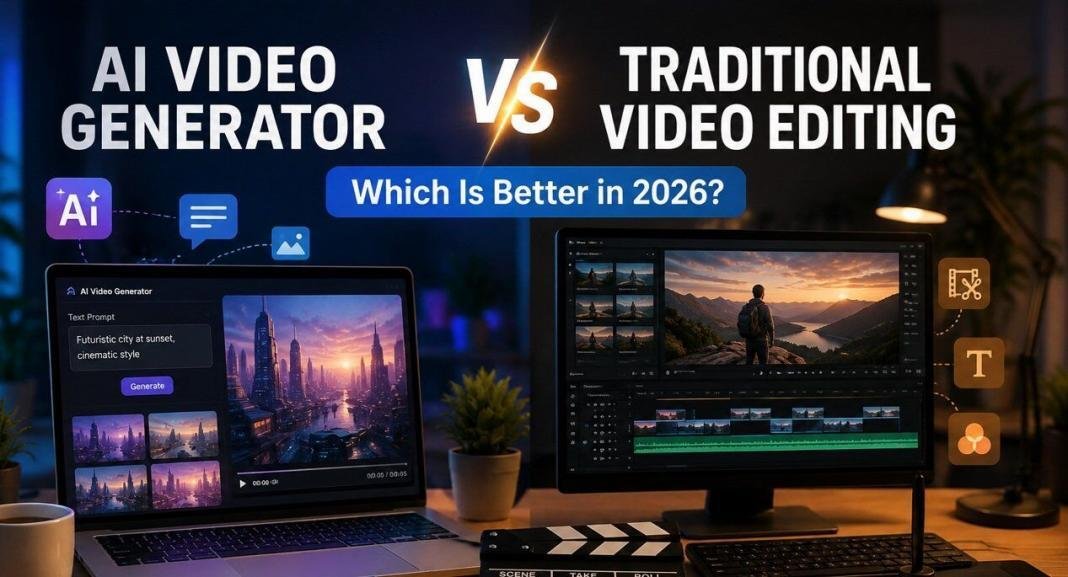
Over the past few years, video production has transformed significantly. In the past, creating even a brief professional video typically required several hours of manual labour, cameras, footage, editing software, and voiceovers.
AI can now create video scenarios from text, pictures, or concepts, greatly speeding up content creation. However, when you need exact control, narrative consistency, and expert finishing, traditional editing is still very helpful.
Which is superior in 2026, then?
The truth is that neither is superior in every situation.
For speed, ideas, short-form material, and scalable production, AI video generating is great. When every frame, transition, sound, and narrative element counts, traditional editing works better.
Combining the two is actually the best strategy for many creators.
AI Video Generator vs Traditional Editing at a Glance
| Factor | AI Video Generator | Traditional Video Editing |
| Speed | Very Fast | Slower |
| Learning Curve | Low | Medium–High |
| Creative Control | Prompt-based | Frame-by-frame |
| Cost | Usually lower | Can be higher |
| Original Footage | Not always required | Usually required |
| Scaling Content | Easy | Time-consuming |
| Best For | Reels, concepts, ads, B-roll | Films, commercials, detailed projects |
AI video tools are particularly useful when you need many variations quickly, while traditional editing provides much deeper control over the final result.
What Is an AI Video Generator?
An AI video generator creates video content using artificial intelligence.
Instead of starting with a camera, you can start with a simple instruction such as:
“Create a modern product advertisement for a luxury skincare brand with cinematic lighting.”
For example, Xelta’s AI Video Generator allows users to create videos from descriptions and offers different generation options for short-form, explainer, product-demo, animation and live-action-style videos.
What Is Traditional Video Editing?
Traditional editing starts with existing footage.
An editor imports videos into software, arranges clips on a timeline and manually controls:
- Cuts
- Transitions
- Music
- Voice
- Color
- Effects
- Captions
- Timing
This workflow remains important for professional productions because editors can control the video almost frame by frame.
H3: Where Traditional Editing Wins
Traditional editing is especially useful for:
- Films
- Documentaries
- Premium advertisements
- Interviews
- Brand films
- Long-form YouTube videos
- Client projects requiring exact revisions
H2: AI Video Generator vs Traditional Editing — Real Example
Imagine a digital marketing agency needs 10 Instagram videos for a new product.
Traditional Workflow
The agency may need to:
- Add captions
- Plan the shoot
- Record footage
- Transfer files
- Select clips
- Edit each video
- Add music
- Export different formats
This can take significant time.
AI-Assisted Workflow
The team can:
- Write the concept
- Generate scenes
- Create multiple variations
- Add voice and captions
- Review the output
- Make final edits
This makes AI particularly useful for high-volume marketing content.
Features Comparison
H3: Speed
Winner: AI
AI can produce a usable first draft much faster than a traditional production workflow.
Creative Control
Winner: Traditional Editing
Editors can control individual frames, timing, colors and effects.
Cost
Winner: AI for many short-form projects
AI can reduce the need for cameras, locations and production crews, although subscription and generation-credit costs still need to be considered.
Scalability
Winner: AI
If you need dozens of content variations, AI can make experimentation much easier.
Professional Storytelling
Winner: Traditional Editing
For complex narratives, human creative direction still matters enormously.
What About Quality?
This is where people often make the wrong comparison.
AI-generated video can look impressive, but visual quality isn’t the same as storytelling quality.
A beautiful AI scene can still have:
- Poor pacing
- Inconsistent characters
- Incorrect details
- Weak messaging
- Unnatural movement
Traditional editing doesn’t automatically create a good video either. The quality depends on the footage and the editor.
So the real formula is:
Good Footage + Good Story + Good Editing = Good Video
And increasingly:
AI Generation + Human Direction + Editing = Efficient Professional Workflow
Current industry discussions also point toward hybrid workflows rather than AI completely replacing professional editing.
Benefits of Combining AI + Traditional Editing
This is probably the most practical approach in 2026.
Use AI for Speed
Generate:
- B-roll
- Backgrounds
- Concepts
- Product scenes
- Social clips
- Visual experiments
Use Traditional Editing for Polish
Then use an editor for:
- Final cuts
- Brand consistency
- Color correction
- Audio mixing
- Story pacing
- Final quality control
This gives you the speed of AI with the control of human editing.
Where Xelta AI Fits In
Xelta AI is particularly relevant for marketers and creators who want to reduce the distance between an idea and a finished video.
Its AI Video Generator supports multiple video-generation use cases, including short-form videos, explainer videos, product demos, animation and live-action-style content.
Xelta USP
Instead of treating AI video as something only professional filmmakers can use, Xelta focuses on making video creation accessible through a simple AI-driven workflow.
For a marketer, the process can look like:
Idea → Prompt → AI Video → Voice/Music → Edit → Social Media
That can be much faster than starting every project with a complete production setup.
Buying Guide — Which One Should You Choose?
Ask yourself these questions before choosing a workflow.
Need 10–20 short videos every month?
AI video generation can be a better starting point.
Making a documentary or brand film?
Traditional editing is likely more suitable.
Need quick ad variations?
Use AI + human editing.
Need exact control over every frame?
Choose traditional editing.
New to video creation?
An AI-first workflow can reduce the learning barrier.
Expert Advice
Don’t choose AI simply because it is faster.
And don’t choose traditional editing simply because it is familiar.
Instead, divide your workflow into two parts:
AI handles repetitive production.
Humans handle creative decisions.
This approach is already reflected in modern production workflows, where AI is increasingly used alongside human judgment rather than as a complete replacement.
Frequently Asked Questions
Is AI video better than traditional video editing?
Not universally. AI is better for speed and scalability, while traditional editing is better for detailed control and complex storytelling.
Can AI completely replace video editors?
For many simple tasks, AI can automate significant amounts of work. However, creative direction, storytelling, pacing and quality control still benefit greatly from human editors.
Is AI video cheaper?
It can be, especially for short-form content and repeated variations. But you should compare subscription fees, generation credits and the quality of the final output.
Can Xelta AI create videos without filmmaking experience?
Yes. Xelta’s AI Video Generator is designed around a simple prompt-driven workflow and states that users don’t need filmmaking experience or expensive equipment.
What is the best workflow in 2026?
For most marketing and creator workflows, a hybrid AI + traditional editing workflow offers the best balance between speed, creativity and control.
You may also like to read,
- Looking for Remote Access to Download Videos? There’s a App for That
- The Evolution of Wedding Photography: What’s Trending