
Introduction
Legal drafting has been treated as a key legal skill for many years rather than a business process. Lawyers created documents manually, they relied on personal collections of precedents, and they spent many hours polishing clauses, formatting agreements, and checking revisions. Although this method laid the groundwork for modern legal practice, it also resulted in inefficiencies that are becoming more and more difficult to eliminate in the legal environment that is characterized by rapid changes.
People who use legal services want them to be done in less time, organizations require more consistency from law departments, and legal teams are getting bigger demands for work without a matching increase in resources. That means legal drafting has gone beyond producing legal documents. It is now a strategic function that affects productivity, compliance risk management, and client satisfaction.
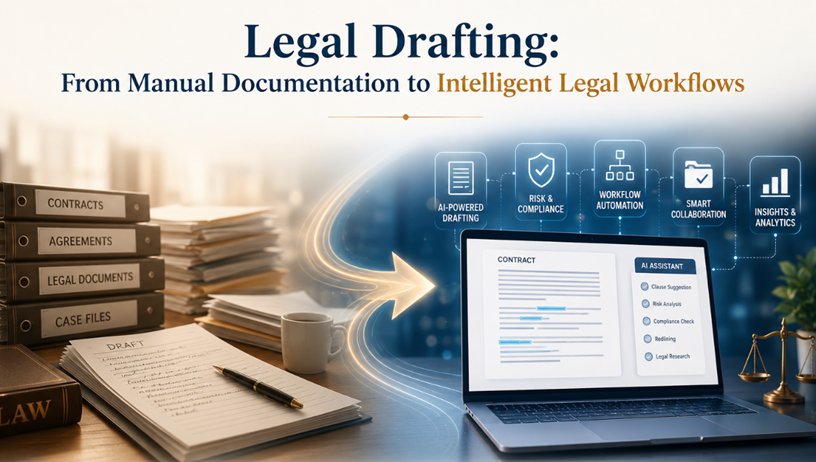
New legal technology is causing major changes to the way that legal professionals do legal drafting. Structured workflows, centralized knowledge repositories, document automation, and AI-assisted tools are among the things that legal teams use to enhance their efficiency while still maintaining quality. Legal drafting today is moving away from being just concerned with creating documents to being a process-oriented activity that is in line with the overall goals of legal operations.
The Hidden Cost of Poor Legal Drafting
Poorly drafted legal issues result not only in document-related problems but also in far-reaching consequences. For instance, the use of ambiguous language, lack of consistency in the choice of terms, and retention of old clauses in a contract may cause legal uncertainties that could influence negotiations, compliance efforts, and dispute resolution.
Organizations may end up being exposed to costly litigation or long disputes when their contracts involve unclear obligations or conflicting provisions. Courts, regulators, or contract parties may interpret even small drafting inconsistencies differently, resulting in legal disputes.
Economic loss comes as the biggest consequence here. In fact, lawyers have to spend hours and even days working on the errors, revising, and correcting the agreements that, if properly written at the outset, would not have resulted in such issues. The problem is that these inefficiencies add to legal fees and also slow down business operations.
Besides the issue of risk and cost, bad drafting may also lead to a loss of client confidence. In fact, people tend to judge a lawyer’s professionalism by their legal documents. Because of this, precise, clear, and properly arranged drafting will not only enhance trust but also make the lawyers’ work much easier by preventing legal troubles that they would otherwise have to deal with.
Why Legal Drafting Consumes More Time Than Most Lawyers Realize
Many people in the legal profession recognize drafting mainly as writing. In fact, writing is just a single part of a much bigger process. A lawyer spends a lot of time before producing the first draft to collect facts, to look at precedents, to do legal research, and to find out how to make the document.
Drafting is also a circulation work. Sometimes there are only clients and colleagues, other times compliance teams and business decision-makers are involved as well. Talk is process changes, while each review adds more revisions and approval requirements that further lengthen timelines.
Version control brings yet another issue. It is common for legal professionals to have work on several document drafts simultaneously, making change tracking and identifying the latest draft really difficult. With the increase in document complexity, the administrative side of work may end up requiring as much time as legal research and constructive analysis.
Knowing the whole drafting workflow explains why a lot of legal departments are looking for more formal and technologically inspired methods to legal drafting.
The Anatomy of a Well-Drafted Legal Document
There are a few key elements to effective legal drafting that keep documents clear, enforceable, and capable of meeting their purpose.
Clarity
Legal documents should be drafted in such a way that obligations, rights, and processes are communicated in simple language and are difficult to misinterpret. Clarity is one of the most important tools in avoiding confusion and misuse of the contract ideas by both parties.
Precision
Each word used in a legal document should be chosen carefully and based on its definition. When accurate terms are used, misunderstandings will be reduced, and the legal will of the parties will be reflected more directly through the text.
Consistency
Within one piece of writing, the use of terms, layout, and clause construction should be maintained uniformly. Readability is increased with consistency, and it can really limit the possibility of the same text being “interpreted” differently in two instances.
Enforceability
Legal documents should be executed following the applicable laws and regulations. Carefully drafted clauses increase the effectiveness of implementation, and at the same time, they minimize vulnerability to legal disputes.
Jurisdictional Relevance
A legal draft should incorporate the relevant regulations, criteria, and methods of the jurisdiction concerned. Ignorance of jurisdictional requirements in the creation of the document often means both compliance and enforceability issues.
Common Drafting Challenges Across Different Practice Areas
Besides the structure, language, and review of the documents, each area has other issues that should be accounted for, which affect the legal drafting.
Litigation
A litigation lawyer has to be very careful when drafting documents like pleadings, affidavits, and submissions to the court with a view to ensuring that they are proper and can support the persuasive legal arguments to be made therein. The drafting must also comply with safeguarded judicial review at all times.
Corporate Law
A corporate lawyer is involved with various kinds of agreements, governance documents, and transaction records. One of the major issues in such type of work is how to keep consistency in producing a large number of documents, which is practically very difficult without some kind of standard processes.
Employment Law
Employee-related paperwork usually needs continuous renewal to match the latest amendments in the laws and rules, as well as internal policies. Making sure all the aspects are taken care of while keeping the text easy to understand is always a major goal.
Real Estate
Real estate drafting is characterized by making arrangements for complicated contractual obligations, addressing the issues of title, and taking into account the regulatory requirements. A seemingly insignificant error may cause the transaction to fail.
Regulatory Compliance
Legal teams have to implement changes in their language and procedures continuously to comply with changing legal and regulatory setups. Compliance documents have to be aligned with the legal and regulatory obligations that are constantly changing.
The Shift from Templates to Intelligent Drafting Systems
Legal professionals have, for many years, resorted to static templates kept in their personal archives, shared drives, or folders. Although templates were the main method of work, they inadvertently led to problems. Different versions of a document were forwarded amongst team members, users of old clauses were still there, and lawyers had to spend a lot of time changing the text to match the particular case manually.
Contemporary legal drafting is gradually doing away with mere paper templates and leaning more toward smart drafting systems. Rather than having hundreds of separate documents, companies are putting together a collection of approved clauses, standardized language, and drafting workflows.
Consistent with the shift, there is an enhancement in the quality of documents and a reduction in the preparation time. While lawyers will still need their in-depth knowledge for legal strategy and risk analysis, they will be relieved of the monotonous tasks of formatting and document assembly. Legal drafting software even gives the option to change the language in multiple document types simultaneously, which is quite a challenge when laws, regulations, or internal policies change.
Due to the growing complexity of legal work, law firms and legal departments that are equipped with structured drafting systems have no difficulty in creating documents quickly without compromising on quality.
Building a Standardized Legal Drafting Process
Consistency in legal drafting hardly ever comes about unintentionally. It is up to a thoughtful process to determine how documents are created, reviewed, approved, and maintained throughout the organization.
Centralized Precedent Libraries
Centralized repositories are instrumental in affording legal professionals access to authorized and current precedents. This lessens duplication and prevents reliance on outdated documents.
Approved Clause Banks
Clause libraries are a means of standardizing the legal language in contracts, notices, and agreements at the organizational level. Lawyers are able to spot approved provisions swiftly, which aids in preserving drafting consistency.
Review Workflows
Organized review procedures guarantee that documents undergo necessary legal, business, and compliance scrutiny before being finalized.
Version Control
Overseeing document versions is a fundamental aspect of keeping correct and open records. Version control systems lessen misunderstandings as well as offer a clear history of changes.
Drafting Governance
Companies that set up drafting standards with governance policies end up establishing more rigorous quality controls. This not only helps consistency maintenance but also helps in the development of stronger teams and practice areas.
For one thing, standardizing the drafting process leads to enhanced document quality. On the other hand, it lays the groundwork for expanding legal operations.
What Modern Legal Teams Expect from Drafting Technology?
Legal technology has greatly changed in the past 10 years. The basic tool of document creation no longer satisfies the needs of the modern legal professional. These professionals require software that will allow them not just to be efficient but also to work in a team and have access to the knowledge stored within the documents while they are drafting them.
Faster First-Draft Creation
Lawyers get a great deal of help from computer programs that use structured templates, clause repositories, and automated workflows in producing first drafts faster.
Collaborative Reviews
In most cases, more than one person is involved in drafting a document. Collaboration software enables easy reviewing, commenting, and approving, and even the changes and reworks are done without going through the tiresome process of emails and their chains.
Secure Document Management
The practice of law cannot be conducted without a high level of confidentiality. Secure document storage and selective access are the measures taken to protect secret information.
Workflow Integration
Legal drafting is a matter of connecting different legal services, like matter management, compliance tracking, research tools, and document repositories, to make a smooth and efficient workflow.
Searchable Legal Knowledge
With the ability to search previously prepared work, approved clauses, and internally available legal knowledge, the legal professionals can make faster and better-informed decisions while drafting.
All these possibilities indicate the increased integration of legal operations such that drafting is only one function among others in the whole legal system.
The Future of Legal Drafting Is Process-Driven, Not Document-Driven
Speeding up the generation of documents is only a small part of what will determine the future of legal drafting. It will be about reengineering drafting as an interconnected workflow that facilitates various legal and business objectives.
Legal departments are bringing together drafting and research platforms, matter management systems, compliance workflows, contract repositories, and knowledge management tools. They are putting together a single platform where information is freely moving among the various facets of legal operations.
Rather than submitting each document as a standalone job, companies are designing mechanisms that record and leverage the collective experience of the firm to drive ongoing enhancements. This way, drafting is connected with legal risk management, compliance, and effective legal service delivery.
Besides enhancing these capabilities, new technologies will be a part of the change. Though the most important change will be at the level of the organization itself. Legal departments are coming to understand that the quality of drafting is as much a function of process and knowledge management as it is of the lawyers’ skills.
Those firms and legal teams that understand the meaning of and embark on this change will be able to cope with increasing requests and still keep their quality and consistency.
Conclusion: Legal Drafting as a Strategic Legal Capability
Legal drafting has really progressed from just preparing contracts, pleadings, and other papers. In fact, nowadays it is a major strategic tool that helps in improving efficiency, managing risks, compliance, and serving clients better.
With the increasing complexity of legal matters, organizations can no longer rely on manual drafting only and scattered approaches to document management. Legal professionals can be assisted in working more effectively and with the accuracy required by law through well-defined processes, consolidated legal knowledge bases, smart drafting systems, and AI-powered tools.
Top legal teams are not just acquiring new technologies. They are rethinking the way drafting is carried out, reviewed, and controlled throughout the organization. By merging legal skills with automated workflows and advanced tools, they are capable of producing better documents faster and more consistently.
The winning edge of legal drafting, in this prospect, is in organizations that see it not as mere paperwork but as an essential part of modern legal operations and achieving legal excellence over the long run.
You may also like to read,
- Legal Tech Reinvented: How Intelligent Case Management Solutions Speed Up Justice
- AI Legal Software: Transforming the Future of Legal Work
- Streamlining Legal Workflows with Smart Legal Document Templates
- Legal AI: Redefining How the Legal Industry Operates
- Transforming Legal Workflows with AI Case Management Software


This is an interesting perspective on how legal drafting is evolving from traditional manual document preparation toward more structured and technology-driven workflows. I especially found the points about clarity, precision, consistency, and jurisdictional relevance important, as these factors can significantly influence the quality and effectiveness of legal documents. Legal drafting is also highly relevant in areas such as employment law, contracts, immigration matters, and disputes, where clear and accurate documentation can make a significant difference. It is valuable to see how modern legal teams are combining professional legal knowledge with better processes and technology to improve efficiency and reduce legal risks. As a legal practice, Advantage Law Firm
also understands the importance of clear and precise legal documentation when helping individuals and businesses navigate complex legal matters.