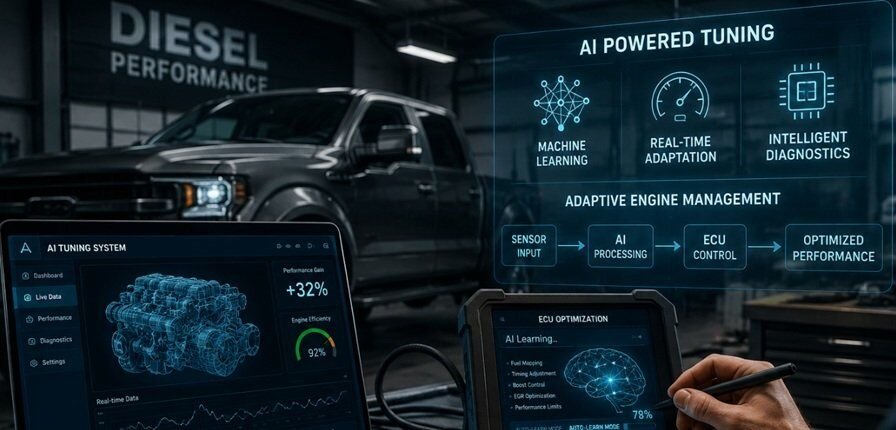
Now let’s talk about how diesel performance tuning is evolving right here under our feet. Previously, when you were planning a modification of your 4×4 or heavy-duty vehicle, it was like blindly trying to hit the target. You would put the vehicle on the dynamometer, do some adjustments of maps by hand, and hope that all goes well until the car tells you it works the way you want. However, when you take a closer look at the current trend of diesel tuning, it proves to be entirely different.
Artificial intelligence, machine learning, and advanced computational power are changing the engine control landscape. Artificial intelligence is not just a fancy term but a valuable instrument that makes our plant more intelligent. We can now analyse things in real time and suggest ways of keeping our engines healthy. Consequently, our diesels will have higher performance and increased lifespan.
Ditching Fixed Maps for Smarter Diesel Engine Control
For decades, traditional engine management systems simply kept doing their thing: they relied on very rigid, static control maps. Old-fashioned, rule-based control setups were incapable of on-road adaptation since they just followed the fixed settings. As a result, the use of diesel fuel has been increased and worse emission was pumped out most of the time.
That’s completely changing with the era of adaptive real-time control:
- Blink-of-an-Eye Adjustments: Next-generation “Smart EMS” configurations blend live sensor data with machine learning to adjust parameters like fuel injection dynamically and instantly.
- Juggling Multiple Targets: Advanced algorithms, such as NSGA-II, can balance conflicting goals at once. To put it simply: they squeeze out maximum fuel efficiency while actively minimizing nasty NOx and CO2 emissions, all without putting your engine’s lifespan on the chopping block.
Now, if you’re scratching your head, wondering what electronic fuel injection mapping is actually trying to achieve, think of it as orchestrating hundreds of microscopic adjustments to perfectly mix air and fuel in the combustion chamber. Modern AI systems literally learn a tuner’s unique style over time, identifying patterns in massive datasets to automatically highlight relevant maps, and then suggesting baseline tweaks right off the bat.
Your Digital Workshop Assistant for Smarter Diesel Tuning
Imagine AI as your very best digital assistant in the workshop. Contrary to what most people think, it is not replacing you but is there to help you reduce the workload.
- Sifting Through the Mess: New-age tuning software uses AI to instantly identify the patterns between different ECU brands. Rather than wasting hours on analysing data spreadsheets manually, the system highlights by itself the key torque, ignition, and fuel request maps that are needed.
- Brilliant Safety Nets: Suppose a tuner inputs by mistake a boost level that would usually catapult the connecting rods of the engine out of place, the AI would detect this wrong action right away.
Human Expertise Still Matters in Diesel Tuning
But, first of all, it should be noted that general-purpose AI will never replace the next self-tuning mechanic. All depends on specific devices and ways of using them. As the test results demonstrated, ChatGPT generated too lean lambda numbers and totally incorrect volumetric efficiency tables. Any attempt to use such tuning recommendations for your car will lead to the enormous use of fuel trim by the car in order not to make the engine lock up. It is really true that artificial intelligence is very good at efficient operation. However, there is something that can never be replaced by AI – a mechanic’s experience.
This blend of high-tech automated assistance and expert human intuition is quickly becoming the benchmark for premium car tuning in Melbourne and garages across Australia.
Seeing Trouble Before It Strikes
It’s not just about raw power, either. AI is turning maintenance from a reactive nightmare into an exact science.
- Forecasting Failures: What’s the point of waiting for a component to give up on you? Predictive methods as machine learning, can see what’s about to happen just by looking at sensors’ historical and real-time records. For example, with such a model, you can predict a failure of a pivotal aftertreatment part, say a NOx sensor, much before the check engine light appears.
- Virtual Wear and Tear: Engineers simulate actual conditions of a machine and its parts via digital representation or “Digital Twins”. They get information about the remaining life of the part this way.
- Lifting the Lid on the Black Box: “Explainable AI” tools like SHAP help to disclose the black box mystery. They explain to the operator the reasons for the upcoming failure, like an increase in RPM to an unreasonable level and a big variation of the engine coolant temperature.
Final Thoughts:
To conclude, it must be stressed that in the context of automation, artificial intelligence is not a panacea, which would make car mechanics unnecessary, but rather a great improvement, which allows them to do their job better and make fewer mistakes. In addition, when deep learning becomes widespread, it will allow cars to constantly adapt and tune their performance, thus generating more power while remaining eco-friendly. This is indeed a great future for the lovers of diesel engines!
To conclude, it must be stressed that in the context of automation, artificial intelligence is not a panacea, which would make car mechanics unnecessary, but rather a great improvement, which allows them to do their job better and make fewer mistakes. In addition, when deep learning becomes widespread, it will allow cars to constantly adapt and tune their performance, thus generating more power while remaining eco-friendly. This is indeed a great future for the lovers of diesel engines!
You may also like to read,