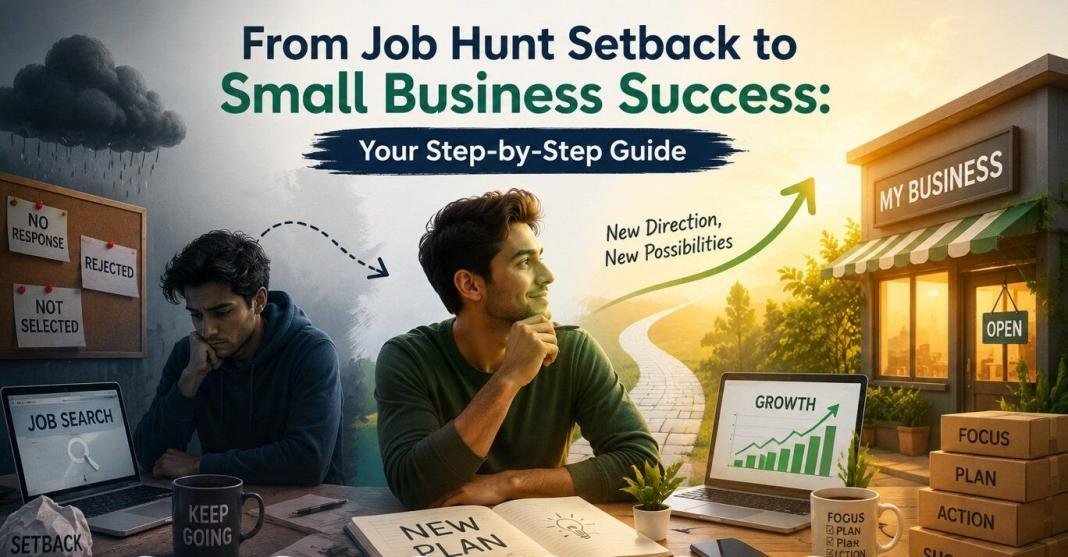
For job seekers in career transition, a failed job hunt can feel like a personal verdict, even when the real problem is a crowded market and shifting hiring rules. Weeks of applications, silence, and polite rejections create a brutal tension: skills are real, but the traditional route isn’t opening doors. Self-employment isn’t a consolation prize, it can be a practical way to reclaim control and turn proven strengths into a small business startup with clear value. This is about spotting entrepreneurship opportunities already hiding in the work experience and frustrations job seekers carry every day.
Turn Your Skills and Frustrations Into a Business Idea
This quick process helps you translate what you already know how to do and what’s been bothering you in your job search into a few business ideas you can test right away. It matters because you do not need a perfect plan to start, you need a clear problem, a real customer, and a small first offer.
- Take a fast inventory of what you can do
Start by writing down strengths, gaps, and the kinds of work you reliably deliver, even under pressure. A simple self-assessment of your skills keeps you grounded in reality, not wishful thinking. This becomes your “toolbox” for choosing ideas you can actually execute. - Sort your skills into three buckets
Brainstorm or mind-map your skills, and label each item as Content (what you know), Methodology (how you do it), or Interests (what you could happily learn more about). This makes hidden assets visible, like “explaining complex info” or “fixing broken processes,” not just job titles. - Convert frustrations into customer needs
List 5 to 10 moments when you felt stuck, ignored, or slowed down during your search or previous jobs. For each one, rewrite it as a customer sentence: “I need help to ____ without ____.” This shift turns stress into demand and helps you think like someone who solves problems for others. - Generate 10 offer ideas using a simple prompt set
Pick one skill bucket and one customer need, then create small offers you could deliver in a week: an audit, setup, template, training, or done-for-you fix. Use the SCAMPER method to push beyond obvious ideas, like combining two services or eliminating a painful step for the customer. Quantity first, judgment second. - Choose one idea and define a “first conversation” target
Select the idea that fits three checks: you can deliver it soon, it solves a specific pain, and you know where to find people with that pain. Write one sentence that names the customer and outcome, then reach out to 3 people to ask questions and validate the need. Your goal is clarity, not instant sales.
Keep Proposals, Contracts, and Invoices Share-Ready From Day One
Once you’ve turned your skills and frustrations into a real offer, the next momentum-killer is scrambling to find (or recreate) the documents that make you look credible. From day one, use a simple document management tool to keep your business plans, customer proposals, contracts, invoices, and even marketing materials organized in one place so it’s easy to share, update, and scale your process as your venture grows.
Saving these files as PDFs helps you keep formatting consistent across devices, send a clean “final” version, and reduce the chances of accidental edits when you’re moving quickly with early clients. And when you do need quick tweaks, there are online tools that let you convert, compress, edit, rotate, and reorder PDFs; an online PDF editor can help you make fast fixes without turning the admin into a whole project. With your paperwork share-ready, you’ll be able to move through a clear validation workflow and start winning your first client conversations faster.
Validate → Build → Share → Sell → Learn
This workflow turns job-search frustration into steady forward motion by giving you a repeatable path from “idea” to “paid.” It keeps you focused on learning from real people, not perfecting in private, so you can build confidence and cash flow at the same time.
| Stage | Action | Goal |
| Listen for pain | Interview 5 target people; capture exact phrases and triggers | Confirm a problem worth paying to solve |
| Define the offer | Write who it helps, outcome, price, and proof needed | A clear promise you can explain in 20 seconds |
| Build an MVP | Create the smallest useful version; deliver manually if needed | Fast delivery that tests demand, not polish |
| Share and attract | Post 3 helpful tips; invite replies; track which topic pulls | Consistent conversations with the right audience |
| Outreach and close | Send 10 tailored messages; propose one next step | 2 discovery calls and 1 paid pilot |
| Review and adjust | Update your script, offer, and assets based on feedback | A tighter process that improves every cycle |
Each loop narrows uncertainty: listening shapes the offer, the MVP proves value, and outreach turns learning into revenue. Since 44% of companies emphasize acquisition over retention, your review step is where you win by improving what already works.
Job-Search to Founder: Questions People Ask Most
Q: How do I start a business if I’m low on money right now?
A: Start with a service you can deliver manually, using tools you already have. Price a small “paid pilot” and collect payment upfront or in milestones to protect your runway. Many founders hit cash flow problems, so designing for fast cash-in is a smart first constraint.
Q: What if I’m not confident enough to sell yet?
A: Treat selling as helping, not persuading: ask questions, repeat back what you heard, and offer one clear next step. You are not alone if fear shows up, since fear of failure holds many people back from pursuing business ideas. Build courage through tiny reps, like one outreach message a day.
Q: When is the “right time” to quit applying for jobs?
A: Keep applying while you validate demand, then shift time toward what is producing calls and payments. A practical trigger is when you have consistent conversations and at least one repeatable offer people understand quickly.
Q: How can I look legitimate without a big brand, website, or LLC?
A: Legit comes from clarity and follow-through: a simple one-page offer, a clear price, and documented results from a pilot. Use a professional email, a calendar link, and a short proposal template to make the process feel real.
Q: What should I do if my first idea flops or people ignore me?
A: Assume the idea is a draft, not a verdict on you. Ask two people why they passed, adjust one thing, and run the next micro-test within seven days.
Turn Job-Search Frustration Into Your First Founder Momentum
Job search frustration can make it feel like effort doesn’t matter and opportunities are always just out of reach. The way through is the approach built on entrepreneurial motivation, a growth mindset, and treating setbacks as feedback, so business confidence comes from action, not permission. When that mindset is practiced, overcoming setbacks stops being a personal verdict and starts becoming founder empowerment in motion. Your frustration is information; use it to build, not to stall.
You may also like to read,
- Turning Passion Into a Career: Steps to Find Fulfillment and Success
- How Professional Certifications Boost Career Growth, Confidence, and Earning Potential