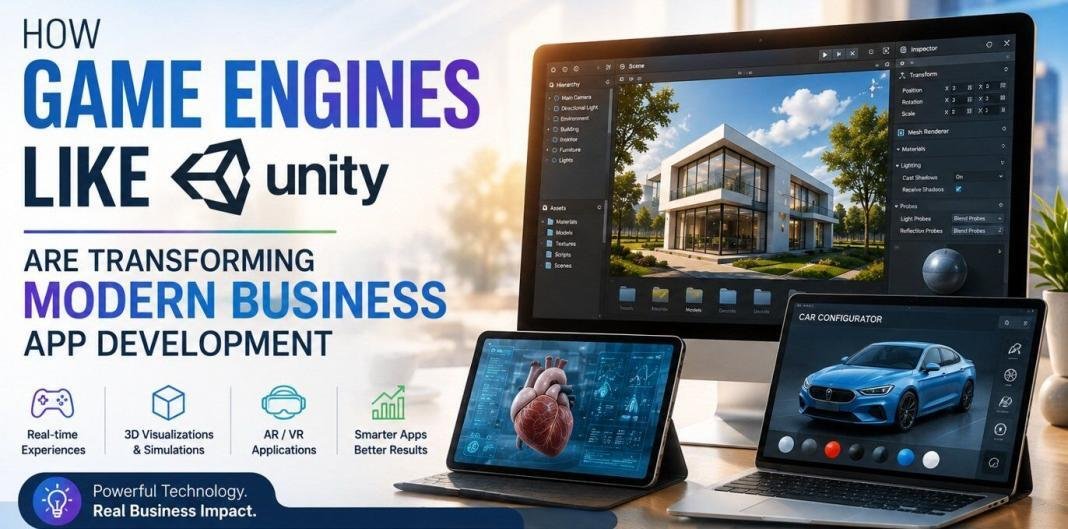
A few years ago, if you mentioned “Unity” at a business meeting, everybody was sure that you referred to a game development company. It could be anything from a game with cartoon characters or just another match-three game.
However, all this has changed very quickly.
Nowadays, if you come to any product-related meeting – retail, real estate, healthcare, manufacturing – there is always a good probability that, one way or another, Unity or Unreal will be mentioned but not to discuss some new game but a 3D product configurator, a training simulation or some AR application.
Game engines have quietly become one of the most useful tools in app development, and most businesses have no idea why.
What a Game Engine Actually Is
Under the hood of marketing phrases, it is simply a set of utilities used for the development of interactive and real-time applications. All the tough things, like graphical representation, physics calculations, handling user’s input, and animations, are provided by it; thus, developers do not have to develop everything anew each time.
Unity was created for the needs of the gaming industry. This is still its core mission. But somehow people found out that the set of tools needed to create a good game is exactly what is required in many other types of software applications too.
Consider what is really needed to develop a useful business application: fast rendering, smooth interaction, platform portability, and support of complex graphics. This is pretty much what a game engine is responsible for.
Why Businesses Started Paying Attention
And here’s why this transition occurred: there were higher expectations from the users.
Applications should be interactive by nature nowadays. It means that users swipe and tap; they want quick responses and quality animation. A sluggish static app is not an option even for such a dry app as an inventory tool or product catalog.
Traditional frameworks excel in the development of forms, lists and buttons, but sometimes fail when it comes to creating something moving, rotating or responding to touch in a 3D environment. This is where Unity and similar game engines come into play.
Some drivers of change are:
Hardware of mobile devices became much more powerful. Mobile phones can provide real-time 3D rendering that was possible before only with a help of a desktop computer. Augmented reality and virtual reality applications left laboratories and were integrated into products that are now available on the market. And the customers expect digital experience before purchasing any product including a car, furniture or shoes.
Once businesses saw what was possible, the question stopped being “why would we use a game engine” and became “why wouldn’t we.”
And there’s yet another aspect here which does not have anything to do with the latest technologies but with finance. Creating a bespoke 3D rendering engine is rather costly and requires a specialized team of programmers several months, sometimes even years, to develop a solution which works properly. The problem of creating a good rendering engine has already been solved by Unity. For more than fifteen years, the company has been developing a tool that makes it possible to render things in real time, which is crucial for its business. By using Unity, the business will avoid the need to create a wheel, but will just use it for its own needs.
It’s especially important for small businesses. A startup that is running low on cash cannot afford to build a rendering engine in order to show its product in 3D. However, it can employ programmers skilled in Unity.
Where Unity Actually Shows Up in Business Apps
Retail and eCommerce. Virtual try-on capabilities, 3D visualization of products and stores, and all such applications rely on the very same rendering technology that is used in gaming. The same technology is used by the user rotating their sneaker in front of them on their mobile device, as well as the rendering of the car in a racing game.
Real estate. Virtual tours for real estate used to be just a sequence of pictures. Currently, they represent a walk-through of an apartment or house in 3D, with changing lighting conditions, flooring materials, and viewing angles depending on time of day. This is the job of the game engine.
Healthcare and training. Surgical simulations, safety training for factory workers, training flights for pilots, much of that is being done with the help of game engines such as Unity or Unreal as they allow creating interactive environments that respond in real-time and can mimic reality.
Automotive. Configurators of cars, where the user picks the color, applies packages, rotates the view of a car model, and instantly sees how that changes. This interactive approach represents one of the features of game engines applied to business.
Manufacturing and industrial. Digital twins, virtual copies of real machines or factory floors, let companies test changes and spot problems before touching anything physical. Building that kind of simulation from scratch would take forever. A game engine gets you there much faster.
None of these are games. All of them use game development tools to get built.
Education. Apps that allow students to perform virtual dissections of frogs or explore a historical battlefield are powered by the very same technology powering open-world adventure games. There is only one thing that differs – the content of the app.
Events and marketing. Companies have begun creating interactive booths, virtual showrooms, and branded AR filters through Unity. A person attending a trade show simply using a smartphone to point at a poster and make a product come alive is possible not because of magic but through rendering – and there is nothing new about that, since game development companies have been honing that skill for years.
Field service and maintenance. Certain organizations have begun using AR overlays created in Unity in order to assist technicians with repairs, allowing them to see exactly how each part fits together or what wires should be connected, overlaid on top of the actual device.
It doesn’t take long to notice this trend when looking for it. In any field where customers, employees or trainees will benefit from seeing and interacting with an object in three dimensions, you can find such a build.
The Actual Advantages, Not the Hype
It’s worth being honest about why this works, instead of just saying it’s exciting.
Unity is free to start and pretty cheap as you expand its usage. Unity applications can be used on iOS, Android, PC and even in web browsers almost from the same codebase. This is invaluable savings for any company that wants to provide their product to customers in any way possible without developing separate products for each platform.
3D is Unity’s core. Business application frameworks were not created to take 3D into account; therefore, it was added as an afterthought in case some applications require it. But Unity was born as a 3D framework from scratch, and its main purpose is to render everything in real time.
Unity has plenty of tools for AR and VR development. Unity has been working on AR and VR features for several years and has tested them by shipping thousands of games and applications. Any company that works on its first AR feature does not need to start from scratch.
Performance is tuned for interaction. Games have to run at 60 frames per second while doing a lot of calculations at once. That same performance discipline carries over, so business apps built on Unity tend to feel smooth even when they’re doing complicated visual work.
The talent pool is bigger than people assume. Because Unity has been the standard in indie and mobile game development for over a decade, there are a lot of developers who know it well. That means businesses aren’t stuck hunting for rare specialists.
None of this makes Unity the right choice for every app. A simple to-do list app doesn’t need a game engine, and trying to force one in would be overkill. But for anything involving rich visuals, simulation, or interactive 3D content, it’s usually the fastest path to something that actually works well.
What This Means for Timelines and Budgets
Most firms thinking about using this type of application often wonder whether this will be more expensive and slower than any other regular app.
And the truth is that this depends greatly on what kind of application you are going to build. The development of a simple 3D viewer for products can now be completed within a few weeks due to the large number of ready-to-use tools and assets in Unity. But the situation becomes different if the application requires custom 3D models, complex animation or a full AR experience and the number of components involved.
Thus, an easy way to understand the situation is this – the development engine itself will not be driving your budget through the roof. Unity is free to start and pretty cheap as you expand its usage. It is the volume of custom content that the application requires, including models, textures, animations and interactions, because all of it should be created manually, just like for a game.
Businesses that plan for this upfront, instead of assuming a 3D app costs the same as a basic form-based one, tend to have a much smoother project. It’s not that Unity makes things expensive. It’s that rich, interactive experiences were always going to cost more than static screens, regardless of which tool builds them.
Where It Gets Tricky
To be fair, using a game engine for business software isn’t free of trade-offs.
A Unity application is likely to be bulky compared to applications based on less bulky frameworks as they have to carry a lot of renderers made for a 3D environment. This is not useful if your application does not require complex graphics.
There is also a learning process for teams made entirely out of business software developers. The workflow of a Unity development project involving scenes and prefabs, among others, is totally different from the conventional web/mobile application development process. A developer familiar with one approach does not necessarily know how to develop applications using the other framework.
There are also some differences in how App Stores/Play Stores review such applications.
None of these are dealbreakers. They’re just things worth knowing before jumping in, so the project gets scoped properly instead of running into surprises halfway through.
Who Should Actually Consider This
If your application will require one of the elements below, then you should definitely consider using the game engine in its development: three-dimensional product visualization, augmented reality or virtual reality capabilities, simulation or digital twin development, educational modules, or all applications that involve exploring the space or an object instead of navigation.
In case when your app consists mainly of form filling, data input and navigation, you won’t need the game engine in development. The standard mobile app development framework will be more convenient and will save time and money.
It’s important to understand what your application really needs, instead of choosing the most advanced solution just because it sounds cool in a pitch deck.
How to Actually Build One of These
Here’s the part that trips a lot of companies up: knowing Unity is the right tool doesn’t mean you know how to use it well.
Game engines have experience to show for it. An individual who has launched a dozen mobile games gets to know certain aspects of performance, memory, and user interaction that cannot be learned from a tutorial. This is because they have gone through all the quirks previously.
This is precisely the reason why more and more firms are now relying on the team that lives within the gamified environment when they require an app like this one built for them.
This is where a company like Cubix fits in. Cubix has spent years building both traditional mobile software through its work as a custom mobile app development Agency, and immersive, real-time experiences.
If you’re weighing whether your next app idea needs this kind of engine under the hood, it’s worth a conversation with people who’ve actually shipped this kind of work before, rather than figuring it out through trial and error on your own dime.
The Bottom Line
While initially designed as an entertainment platform, game engines have outgrown that niche. The quiet emergence of Unity among other platforms has been one of the best platforms for developing applications requiring graphics and smooth performance of real-time 3D content, regardless of the application being a game.
While it isn’t a problem for companies not using game technology in their applications, since many apps are not in need of any such technology, it is certainly a waste for those applications that require rich visual experience and which use software not designed for that purpose.
The distinction between “game technology” and “business technology” is much more blurry than most people think. And it can bring great opportunities to the right type of apps.
Frequently Asked Questions
Is Unity only for making games?
That may no longer be true. As an engine designed for gaming and gaming only, Unity still serves mostly that purpose, but is used for product viewers, AR apps, simulations, and more. There’s no difference in the rendering and interaction process regardless of whether the software is built for games or business apps.
Do I need a game development team to build a business app in Unity?
While you don’t necessarily need to hire a full-fledged game development team, you certainly need Unity-specific developers rather than developers only familiar with Unity’s name. The engine has specific performance nuances which will be hard to account for for someone only familiar with web and mobile development. Many businesses overcome this issue through collaboration with Unity veterans.
Will a Unity-based app be slower or heavier than a normal app?
In case the app needs no advanced visual processing capabilities – yes, since the engine contains rendering functionality for fully 3D scenes. In this case, however, it does not add value and only adds to the app weight. On the contrary, in case of 3D, AR, and simulation – it does all the job needed.
How much does it cost to build a Unity app for business use?
This differs greatly depending on the content, and not the engine itself. Unity is free to use initially and cheap when scaled. The true cost factor is custom 3D modeling, animations, and interaction since all of them need to be crafted manually. A simple product viewer can be assembled in just a few weeks. More complicated AR solution with many custom assets will take more time and money.
Can Unity apps run on both iOS and Android?
Yes. Cross-platform support is the major strength of Unity. Almost all Unity-based applications are developed using a single codebase and then distributed across platforms including iOS, Android, desktop computers, and even web browsers, saving lots of time spent on developing separate native applications.
How do I know if my app idea actually needs a game engine?
Ask whether users need to explore, rotate, or interact with something visual, like a 3D object, an AR scene, or a simulated environment. If yes, a game engine is probably the right call. If your app is mostly forms, lists, and simple screens, a standard app framework will get you there faster and without the extra complexity.
You may also like to read,
- The Impact of AR and VR on the Future of Education and E-Learning
- The Future of Augmented Reality Marketing
- Exploring the World of 3D Graphic Design: Techniques and Trends
- Why is 3D printing technology the future of manufacturing?