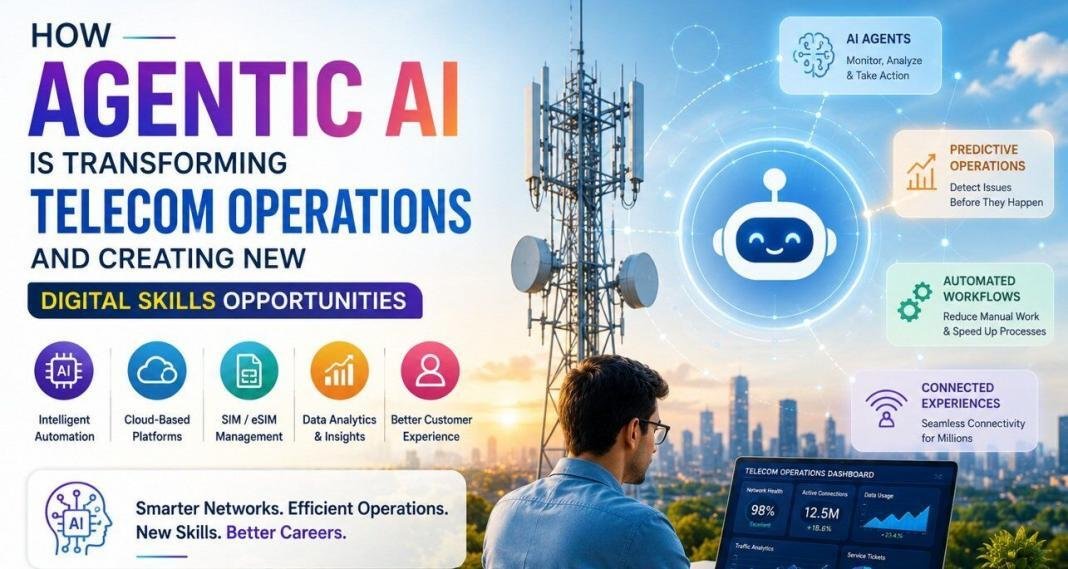
Significant changes are taking place in the telecom industry. High-tech telecom operations that once relied on tedious, manual procedures, complex systems, and disconnected tools are becoming more intelligent, automated, and software-based.
The emergence of advanced AI agents and automation platforms is changing the way businesses work in providing connectivity services to customers and optimizing their operations. This transformation gives professionals a chance to build skills in AI, cloud-based systems, automated platforms, and digital infrastructure.
Transition From Traditional Telecommunications to Intelligent Connectivity Systems
For decades, telecommunications operations have been based on vast infrastructure investments and a specialized team that is responsible for setup, billing, customer service, network integration and service delivery.
However, today businesses need agile connectivity solutions more than ever. Companies engaged in the provision of IoT services and digital products as well as travel connectivity solutions and branded mobile services, need timely implementation of their services without going for the construction of telecommunications infrastructure.
This is the point where telecommunications SaaS platforms and MVNO/MVNE solutions come in handy.
These systems allow companies to carry out telecommunications processes easily and effectively by automating the process through:
- SIM and eSIM provisioning
- Customer onboarding
- Billing management
- Usage monitoring
- Partner and carrier management
- Connectivity analytics
The result is a more scalable and efficient approach to telecom management.
What Are Agentic Telecom Platforms?
Agentic AI is emerging in telecom as a way to combine AI-driven reasoning, automation and interaction across connected operational systems.
Agentic systems can carry out complex operations beyond simple script-based working, with the possibility of setting goals and taking measures across related systems.
Examples of Agentic Telecom Operations
Here are instances of the sector’s work:
- Discovering unusual patterns
- Advising on the best connectivity alternatives
- Assisting with customer service processes
- Improving operations
- Rendering aid to enterprises implementing connectivity on a large scale
All of these procedures will allow telecommunications operators to spend less time on routine operations and focus on strategic issues in the future.
Skills Required for Telecom SaaS
The development of SaaS telecom is driving the need for experts possessing knowledge of both the technological and commercial sectors.
The following competencies are especially crucial:
AI and Automation
A specialist with knowledge of AI workflows and automation technologies can make a company more productive and cost-effective.
API and Cloud Knowledge
Modern telecom platforms are based on APIs and cloud technology. Understanding how to connect processes and manage data flows will become even more relevant.
Data Analytics
Telecommunications companies across the globe create huge amounts of data. Experts who can analyze this data can help organizations understand usage patterns and make more informed operational decisions.
How Telecom Teams Can Adapt to Software-Driven Operations
The shift toward AI, automation, and SaaS is changing more than the technology used in telecommunications. It is also changing how teams organize their work and solve operational problems.
Instead of relying on separate systems for every task, telecom professionals increasingly need to understand how different processes connect and how data moves between them.
Map Repetitive Processes
The first step is identifying tasks that consume significant amounts of employee time but follow predictable patterns. These may include data entry, reporting, customer requests, service activation, or routine monitoring.
Mapping these workflows helps teams determine where automation can provide the greatest value.
Connect Data Across Systems
Telecom operations often involve multiple platforms, databases, and applications. Understanding how these systems exchange information can reduce duplicated work and improve operational visibility.
Professionals with knowledge of APIs, integrations, and cloud environments can play an important role in connecting these processes.
Combine Automation With Human Oversight
Automation does not mean removing people from the decision-making process. For complex or high-impact situations, human oversight remains important.
A practical approach is to automate repetitive activities while allowing employees to review exceptions, validate recommendations, and handle situations that require judgment.
Measure the Operational Impact
Successful automation should produce measurable improvements. Teams can track metrics such as processing time, error rates, response times, operational costs, and customer satisfaction.
This makes it easier to determine whether a new AI or SaaS workflow is actually improving the way the organization operates.
Build Cross-Functional Skills
As telecom becomes more software-driven, professionals benefit from understanding more than one discipline. Combining telecom knowledge with AI, cloud technology, data analytics, and business process management can create a stronger foundation for working with emerging technologies.
Practical Steps for Professionals to Prepare for the Telecom SaaS Future
Professionals who want to stay relevant in this evolving industry can focus on:
1. Learn AI-Assisted Workflows
Understanding how AI agents automate business processes will become valuable across many industries, including telecom.
2. Develop Technical Fundamentals
Learning APIs, cloud platforms, databases, and automation concepts can help professionals work effectively with modern telecom solutions.
3. Understand Business Use Cases
Technology knowledge becomes more valuable when combined with business understanding. Learn how companies use connectivity solutions for IoT, mobility, enterprise services, and digital products.
4. Follow Industry Transformation
Telecom is no longer only about networks. It is becoming a software, data, and automation-driven industry.
The Future of Telecom Careers
The future telecom workforce will combine technical knowledge with business problem-solving skills.
Roles will increasingly require professionals who can understand:
- AI-powered automation
- Cloud-based telecom platforms
- Customer experience systems
- Data-driven decision-making
- Digital service innovation
As telecom companies continue adopting SaaS and agentic technologies, professionals who continuously develop these skills will be better positioned for future opportunities.
Final Thoughts
Agentic AI and telecom SaaS platforms are reshaping how connectivity businesses operate. This transformation is not only improving operational efficiency but also creating new career paths for professionals willing to develop digital skills.
The future of telecom belongs to professionals who can combine technology knowledge, automation thinking, and business understanding to build smarter connectivity experiences.
You may also like to read,
- How Robotic Process Automation Transforms the Telecom Industry for Efficiency and Enhanced Customer Experience
- AI Integration Services: Complete 2026 Guide for Businesses
- Boost Your Marketing Strategy with SMPP Server and Bulk SMS Gateway Solutions