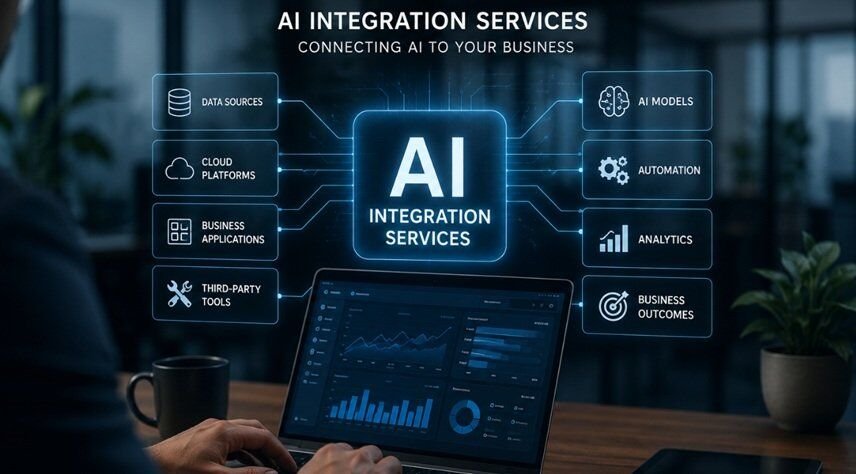
Most companies in 2026 don’t have an AI problem. They have an AI integration problem. The models work. The demos look great. The pilot impresses the leadership team. Then it hits the actual stack of CRMs, data warehouses, legacy ERPs, and homegrown tools, and momentum dies.
AI Integration Services exist to solve exactly that gap. This guide breaks down what the category covers in 2026, the trends shaping it, how to scope a project, and the decision factors that separate a working deployment from a stalled one.
What Are AI Integration Services?
AI Integration Services are professional engineering and consulting work that connects AI models, agents, and APIs to a company’s existing software systems, data sources, and workflows. The goal is to move AI from a standalone demo into daily business operations where it produces measurable output.
A typical engagement covers five layers:
• Model layer: Connecting LLMs, vision models, or speech models to internal applications through APIs or SDKs.
• Data layer: Pipelines that move clean, governed data into the model and store outputs back into systems of record.
• Retrieval layer: Vector databases, RAG setups, knowledge graphs, and embeddings infrastructure.
• Orchestration layer: Multi-step agents that take action across tools (Slack, Salesforce, Jira, SAP, custom apps).
• Governance layer: Authentication, access controls, audit logs, prompt firewalls, and model monitoring.
Integration assumes the models already exist (GPT-class, Claude, Gemini, Llama, open-source variants) and focuses on plugging them into the work.
Why AI Integration Matters More in 2026
Three shifts have made integration the bottleneck of the year.
1. Agentic AI is moving from demo to deployment
Agents that reason, plan, and act across multiple tools are now in production at enterprises. Gartner projects that by 2028, roughly a third of enterprise software will include agentic AI, up from less than 1% in 2024. Deploying these agents demands deep integration with internal APIs, identity systems, and audit trails. A chatbot can be standalone. An agent that books travel, updates a CRM, and files an expense report cannot.
2. Multimodal models change input expectations
Voice, image, video, and document understanding are now standard in frontier models. Integration work in 2026 routinely covers vision-enabled inspection systems, voice-driven customer service, and document parsing pipelines that replace OCR-plus-rules workflows. The connecting code is non-trivial.
3. Compliance is now part of every build
The EU AI Act’s high-risk provisions are now in force, and similar rules are active in India, the UK, and several U.S. states. Integration teams are responsible for logging, explainability, data residency, and human-in-the-loop checkpoints. Cutting corners here surfaces as fines, not bugs.
Core Components of an AI Integration Solution
A production-grade integration usually contains the following pieces. Knowing the parts helps when scoping work or evaluating an AI Development Company.
1. Model gateway: Defines which models, which prompts, and which fallbacks run for each use case. Tools like LiteLLM, LangSmith, and OpenRouter sit here.
2. Retrieval system: A document store, a vector index (Pinecone, Weaviate, pgvector, Qdrant), and chunking logic that lets the AI answer from company data.
3. Agent framework: LangGraph, CrewAI, AutoGen, or a custom framework that runs multi-step reasoning and calls tools.
4. Integration middleware: REST, GraphQL, or webhook bridges into the systems where work actually happens.
5. Security layer: Per-user access controls, prompt injection defenses, output filtering, and PII redaction.
6. Observability: Token costs, latency, hallucination rates, user feedback loops, and drift detection.
Skipping any of these tends to show up six months in, usually as a security incident or a runaway cloud bill.
Top AI Integration Trends in 2026
Small, specialized models alongside frontier ones
Cost pressure has pushed teams toward hybrid setups: a frontier model for hard reasoning, a small fine-tuned model (Phi, Gemma, Llama variants) for the 80% of queries that are routine. Routing logic is now a standard part of any AI Integration Consulting engagement.
RAG is giving way to agentic retrieval
Static RAG pipelines are being replaced by agents that decide what to search, when, and how to combine results. This raises integration complexity but produces noticeably better answers in domains like legal, medical, and engineering.
On-device and edge inference
Apple Intelligence, Qualcomm’s NPU push, and improved open models mean some AI workloads now run on user devices. Integration work covers hybrid routing: device for private or low-latency tasks, cloud for heavy reasoning.
Voice-first interfaces
Real-time voice APIs from OpenAI, Google, and ElevenLabs have made voice agents production-ready. Integration projects increasingly include telephony connectors (Twilio, Vonage) and contact-center middleware.
Governance tooling is maturing
Platforms like Credo AI, Fairly, and Holistic AI are now standard parts of regulated industry deployments. They get integrated alongside the model itself, not bolted on later.
How to Choose an AI Integration Partner
Hiring decisions for Artificial Intelligence Integration Services usually come down to six factors:
• Industry experience: Does the team have shipped projects in your sector? Healthcare, BFSI, and manufacturing all carry domain quirks that generic AI shops miss.
• Model neutrality: Can they work with whichever models suit the use case, or are they locked into one provider?
• Data engineering depth: Working with Snowflake, Databricks, Azure Fabric, or your warehouse of choice should be table stakes.
• Security posture: Look for evidence of work on SOC 2, ISO 27001, HIPAA, or GDPR-bound projects.
• Handoff model: If they hand you a black-box system you can’t extend, your costs will compound. Code ownership and documentation matter.
• Commercial structure: Discovery, MVP, and scale phases need to be priced separately. Lump-sum AI projects rarely end well.
Companies that Hire AI integration developers as a staff augmentation play (rather than a fixed-bid project) often get better results, because integration discovery surfaces requirements that pure project pricing punishes.
A Practical Implementation Roadmap
A clean AI integration project typically runs across four phases over 12 to 20 weeks for a mid-sized scope.
Phase 1, Discovery: Two to three weeks. Map data sources, identify the highest-value use case, validate ROI assumptions, define success metrics.
Phase 2, Prototype: Four to six weeks. Build the smallest working version that touches real data and real users. Measure aggressively.
Phase 3, Production hardening: Four to six weeks. Add security, governance, monitoring, error handling, and the integrations needed for daily use.
Phase 4, Scale and iterate: Ongoing. Optimize prompts, add models, expand to adjacent use cases, retrain where applicable.
Teams that try to skip discovery to look fast almost always end up rebuilding in month four. The cheapest version of an AI Integration Services engagement is the one with a real discovery phase up front.
Where Generative AI Integration Services Pay Off Fastest
Generative AI Integration Services produce the clearest ROI in five areas right now:
• Customer support: RAG-based agents that pull from product docs and ticket history.
• Document processing: Reading contracts, invoices, claims, and forms with structured output.
• Sales operations: Drafting outreach, summarizing calls, scoring leads, and updating CRMs.
• Internal productivity: Copilots for marketing, finance reporting, and engineering.
• Product development: Generative QA, design assistance, and synthetic data for testing.
These use cases share a pattern: high text volume, repetitive structure, and clear human review points. Start there before tackling open-ended creative or strategic work.
Frequently Asked Questions
1. What does an AI integration project typically cost in 2026?
Mid-market projects generally range from USD 30,000 to USD 150,000 for an initial production deployment. Enterprise programs run higher, often USD 200,000 to USD 1M+ depending on the number of systems and compliance scope. Ongoing model and infrastructure costs sit separately, usually a few thousand dollars per month for a moderate workload.
2. How long does it take to integrate AI into existing software?
A focused use case with clean data takes 8 to 12 weeks from discovery to production. Multi-system rollouts with regulated data can run 6 to 9 months. Discovery alone should take two to three weeks; anyone offering same-week production timelines is selling a demo.
3. Do we need our own data scientists to use AI Integration Services?
No. Most 2026 integration work uses pre-trained or lightly fine-tuned models. What you need on your side is a product owner who understands the workflow being automated and a stakeholder with authority to approve data access.
4. What’s the difference between AI integration and AI development?
AI development builds new models or trains existing ones on proprietary data. AI integration connects existing models to your business systems, data, and users. Most companies need integration, not development.
5. How do we measure ROI on AI integration?
Track three categories: time saved per workflow (hours per week), error rate reduction (percentage), and revenue impact (conversion lift, retention, or new revenue lines). Set baselines before going live; without them, ROI is unfalsifiable.
Closing Thoughts
AI in 2026 is no longer a question of whether the model is smart enough. It is a question of whether the integration is solid enough to put real work through. The companies pulling ahead are the ones treating integration as the core engineering problem, not the afterthought.If you’re scoping an integration project or comparing partners, reviewing a dedicated AI Integration Services page that outlines engagement models, supported tech stacks, and case studies across BFSI, healthcare, and SaaS is a useful reference point when building a shortlist.
You may also like to read,
- How Data Science Consulting Helps in Medical Research and Drug Discovery
- Machine Learning Integration in Software Development: Leveraging AI
- Top AI Agent Development Trends Transforming Enterprises