Introduction
The manufacturing sector is undergoing a massive transformation due to automation, data analytics, interconnected systems, and changing customer expectations. Currently, manufacturers are required to operate complex production processes, supply chains, inventory systems, quality standards, and workforce operations simultaneously to deliver efficiency and profitability.
Traditional software and manual processes, in many cases, do not have the capacity or flexibility to meet these rising expectations. As manufacturing environments become more and more dynamic, companies require digital resources that give them the ability to see the production process in real-time, carry out their tasks automatically, and base their decisions on data. This way, Manufacturing Software Development turns out to be the essential business investment.
Tailor-made manufacturing programs allow businesses to reorganize their processes, increase efficiency, lower downtime, and have more control over their activities. Through the creation of software tailored to their specific production environments, manufacturers can solve their unique business problems and, at the same time, be able to support their growth endeavors.
With global manufacturing being continually changed by Industry 4.0, digital transformation is turning out to be a big part that differentiates operational excellence.
What Is Manufacturing Software Development?
Manufacturing Software Development is a term that encompasses the crafting, designing, and rolling out of digital tools meant to be used for manufacturing operations. These solutions serve the purpose of production process management, handling of inventory, supply chain, control of quality, obtaining maintenance, and even running the business operations via a single platform.
In contrast with broad enterprise software, manufacturing solutions are modified to suit very specific industrial workflows and production needs. Also, they can interact with machinery, ERP software, warehousing management systems, and IoT gadgets to establish a well-connected manufacturing setting.
The main focus is to help the factory operate more efficiently, to increase the insight of how and where the products are being made, and to make it easy to decide on business matters via real-time data and automation.
Custom software is indispensable in the present-day manufacturing sectors regardless of whether the kind of production is discrete, process, or even the one done at industrial facilities.
Why Manufacturers Are Investing in Digital Solutions
Manufacturers are being pressured more and more to enhance the level of their productivity while at the same time lowering their expenses and maintaining their quality benchmarks. Doing these things by hand or even by using separate systems will probably bring about inefficiencies and operational bottlenecks.
One of the ways through which Manufacturing Software Development can be of great help to an organization is by assisting them in upgrading their production environments and optimizing their workflows, not only within departments but also across them both.
Generally speaking, digital platforms are capable of delivering real-time information on production performance, inventory levels, equipment utilization, and workforce productivity. Such availability of data is instrumental in enabling managers to spot problems rapidly and arrive at decisions based on complete information.
But, by implementing automation, several things are achieved, like repetitive manual work is eliminated, errors are minimized, and there is greater consistency in operations. That means manufacturers should be in a position to increase production without compromising on product quality and operational control.
Manufacturers that want to be competitive and scalable over time have to undergo a digital transformation, which is actually a necessity and not a choice anymore.
Core Features of Manufacturing Software Solutions
Modern manufacturing platforms pack many features whose main aim is to enhance production efficiency and also give a better insight into the manufacturing process.
Production Planning and Scheduling
Manufacturing plans can be streamlined, production resources can be allocated most efficiently, and production workflows can be made more efficient.
Inventory Management
Keep track of raw materials, work-in-progress inventory, and finished goods at all times.
Quality Control Management
Ensure that product quality standards, inspections, and compliance processes are carried out at every production stage.
Equipment and Maintenance Tracking
Oversee machinery performance, plan preventive maintenance schedules, and use equipment most effectively.
Supply Chain Management
Through connected systems, the coordination and communication with suppliers, distributors, and logistics partners are enhanced.
Workforce Management
Keep tabs on employee productivity, plan and schedule work shifts, and decide on the allocation of labor resources.
Real-Time Reporting and Analytics
Extract meaningful operational insights with the help of dashboards and performance reports.
ERP and System Integration
Integrate production operations with enterprise business systems to facilitate the smooth flow of information.
Manufacturers can use these features to build more connected and efficient operations.
Improving Production Efficiency
One of the main things Manufacturing Software Development looks to achieve is better production efficiency. Manufacturing operations consist of many interlinked processes that need to work seamlessly to fulfill production goals.
With tailor-made software, companies can digitize their workflows and cut down on the time lost to manual work. Operations can be watched live by production managers who can then act swiftly to fix issues that lower the performance.
Machine scheduling that is done automatically will also be able to get the best use of the machines and the workers. So, the resources will be used efficiently, and the production targets will be met.
Manufacturers can increase productivity and keep costs the same by enhancing process transparency and cutting down on waste in operations.
Enhancing Inventory and Supply Chain Management
One of the key parts of a manufacturing business is managing the inventory successfully. Carrying too much inventory results in high costs, whereas having low inventory might cause a halt in production.
Manufacturing Software Development delivers real-time inventory information to the manufacturers, thereby helping them to always be in control of their inventory.
By tracking raw materials, parts, and finished goods at every step of the manufacturing process, manufacturers are able to carry out inventory management accurately. Keeping track of inventory automatically not only leads to an increase in accuracy but also makes it less likely to have inventory differences.
Then again, integration with the supply chain allows for even more efficient operations through good supplier and logistics partner communication.
Thanks to better inventory and supply chain management, manufacturers can reduce waste, planning becomes more effective, and operational agility is increased.
Supporting Quality Control and Compliance
Sustaining product quality at the same level is a critical success factor because it affects customer satisfaction and regulatory compliance. It is hard to control quality manually on a large scale of production.
Contemporary manufacturing systems offer software solutions for monitoring quality indicators, producing records, and tracking inspections.
With Manufacturing Software Development, this can be automated to standardize quality management procedures and recognize faults even before manufacturing.
Automated reporting and audit trails make compliance easier to manage and enable manufacturers to effectively meet industry standards.
Better quality control means less reworking, fewer defects, and more confidence from the customer in the final product.
Leveraging Data for Better Decision-Making
Manufacturing processes produce a huge amount of data every single day. Most of that data remains waste if the manufacturers don’t come up with the appropriate systems.
Manufacturing Software Development allows manufacturing companies to collect operational data and analyze and represent that data in a visual and effective way.
Production machinery inventory and employees’ performance are just some of the areas that real-time dashboards provide data on. It is from this information that managers will be able to read the signs of the times and get a clearer picture of things.
The ability to predict and prepare is enhanced by the use of mathematical and statistical models. Companies will That means be able to adjust their resources to the ever-changing demand and enhance their performance soon.
Manufacturers that rely on data-driven decision-making will be able to operate in a more flexible way and will gain an edge over their competitors.
Industry 4.0 and Smart Manufacturing
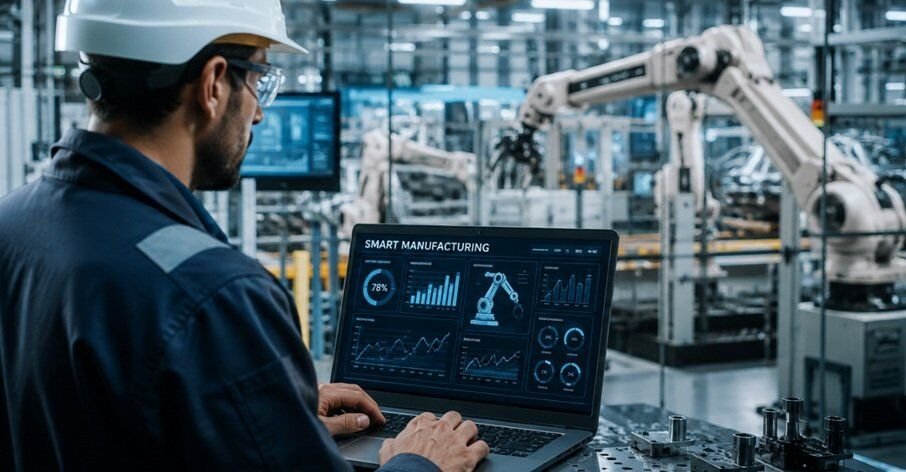
Industry 4.0 is greatly changing the way manufacturing plants are run. For example, IoT AI, machine learning, and cloud computing are making production facilities more intelligent and interconnected. One of the main roles that Manufacturing Software Development plays in such endeavors is integrating various systems, machines, and data sources into a single platform.
Thanks to IoT-enabled devices, production machines and lines send out real-time data continuously. Thanks to AI analytics, the system learns to recognize the patterns, foresee the maintenance needs, and arrange the most effective production workflow.
Cloud-driven systems open the door for better scaling and even remote access, which is rather helpful for managing the operation of several plants. Those who look forward to the industry 4.0 smart factories deployment are already in the best position to increase their productivity and be flexible to the market changes.
Best Practices for Successful Manufacturing Software Implementation
Successful execution starts with a thorough grasp of business goals and operational problems.
It is essential for manufacturers to analyze the existing processes, determine areas of inefficiency, and set tangible objectives for the software project.
Giving top priority to data accuracy and system integration is very important to guarantee correct reporting and the efficient flow of information among different departments.
Training of staff is also a critical factor. It is necessary that the teams learn how to use the new systems effectively to maximize both adoption and productivity.
Usually, a step-by-step implementation plan produces the best outcomes as it enables the organizations to roll out the features one at a time while at the same time limiting the impact on the business.
Ongoing refining is the key to making sure the software goes on serving the changing business needs.
Conclusion
Manufacturing is evolving to be more digital, connected, and data-driven. Those who still bank on old systems and manual operations, may find it difficult to keep pace with the changing market.
The use of manufacturing software development is a way to equip manufacturers with the means to optimize their processes, increase their output, raise their level of quality control, and obtain real-time information about production facilities.
Going beyond the simple integration of automation, analytics, and connected technologies, tailor-made manufacturing software can also be a much better decision-making tool and a path to operational excellence. Besides, it is a step towards Industry 4.0 and a platform for any innovations.
As manufacturing keeps changing, companies that want to grow sustainably, become more efficient, and succeed eventually will have to make a point of buying scalable and intelligent software solutions.
You may also like to read,
- Best ERP Software for Manufacturing Companies: Top Tools, Features, and Benefits
- How Manufacturing Software Development Drives Factory 4.0 Success
- Adapting to Evolving Industries with Custom Solutions
- How Mobile Solutions Are Transforming Workplace Efficiency Across Industries