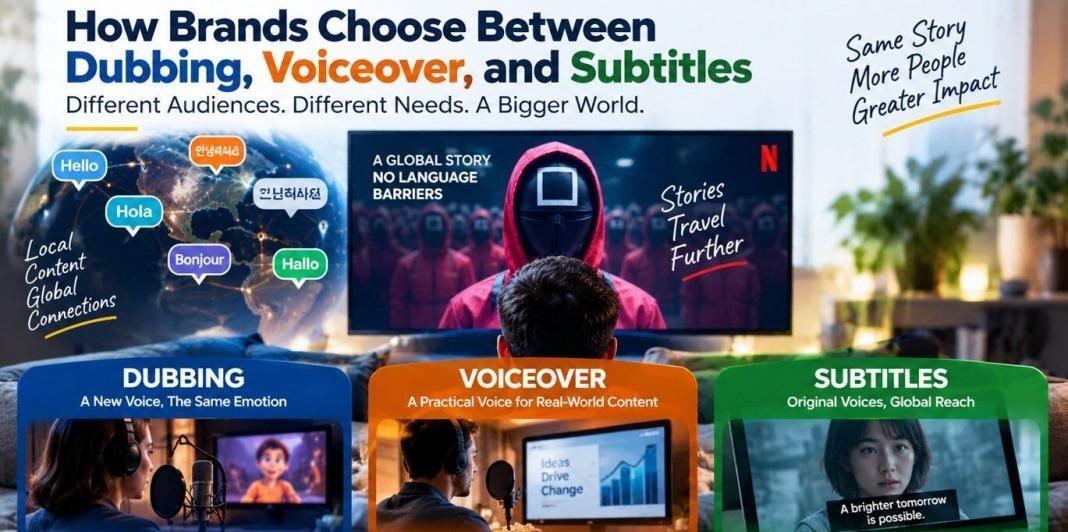
When Squid Game launched globally on Netflix, viewers in different markets could access the series through subtitles and dubbed versions in multiple languages. The show’s international success highlighted an important challenge for global content: localization is not a one-size-fits-all decision.
Viewers in countries with a strong dubbing tradition picked the dubbed track; plenty of others selected content with subtitles just to hear the original Korean performances. The choice reflects a broader reality for global streaming. The Netflix series became the most popular original production on the platform. Moreover, the way it was localized helped to highlight the significance of choosing the right translation and localization methods for different kinds of content.
Few brands operate at Netflix’s scale or budget. Still, the same logic holds regardless of company size. Dubbing, voiceover, and subtitles each solve a different problem, and skipping the basic question of who the audience is before choosing a format. Good video translation services start with the viewer rather than simply choosing the cheapest production option.
Three Methods, Three Different Jobs
Dubbing replaces the original dialogue with a translated performance. Voice actors record translated dialogue that is timed to the characters’ lip movements, pacing, and performance. This is the priciest and slowest of the three approaches. Its biggest advantage is simple: viewers can focus on the visuals and performance instead of reading text throughout the video. That can be useful in markets where dubbed content is widely preferred.
Voiceover works differently. Instead of replacing the original track, voiceover places translated speech over the original audio, which remains audible underneath. Voiceover is used for documentaries, training videos, and news content because it is faster and less expensive than full dubbing.
Then there are subtitles: text on screen and audio left alone. Subtitles are faster and less expensive to produce, and they can also be required for accessibility in some markets and settings. Each method answers a different question, and the mistake most teams make is running this as a cost decision when it should be an audience decision. That’s the gap video translation services are built to close: fitting the method to the viewer instead of defaulting to habit.
What Actually Drives the Right Choice
Regional preferences can vary considerably. For example, Statista, citing GWI research, reported that 61% of surveyed German viewers preferred dubbed versions of foreign-language content, while others preferred the original audio with subtitles. This illustrates why localization decisions should account for regional viewing habits rather than relying on a single global format.
Content type changes the math too. A scripted drama, or a brand film leaning on emotional delivery, usually needs dubbing or strong voiceover performance that carries part of the message, and subtitles alone may not capture that dimension. A product walkthrough doesn’t need any of that. Neither does an internal training clip or a recorded webinar. Subtitles or a straightforward voiceover is often enough, while keeping both production time and costs much lower.
Social platforms get consumed on mute constantly, so subtitles are close to non-negotiable for short-form content. A YouTube tutorial or an online course plays out differently. Viewers typically watch with sound on, making voiceover a practical option, with dubbing worth considering when the budget allows.
A Note on Where AI Fits
Generative AI has changed the economics and turnaround time of video localization. AI tools can assist with transcription, translation, subtitle creation and synthetic voice generation, allowing teams to produce initial localized versions much faster. However, speed does not eliminate the need for human review. Humor, cultural references, tone, terminology and emotionally important dialogue can be difficult to translate accurately without context. For important content, AI is best treated as an efficiency tool within a human-reviewed localization workflow rather than as a complete replacement for linguists and voice professionals.
Wrapping Up
Four questions must be answered before production even begins. Who’s actually watching, and what does the regional data say about
- How do they consume content?
- How much of the message depends on performance and tone?
- Where does the video get watched: sound on, sound off, scrolling past, or sitting still?
- How much time and budget do you have for localization?
There is rarely one localization format that works for an entire brand or content library. But asking these questions up front can help you create content that is more intuitive for the people who are watching it. Ultimately, the goal of video localization is to create a natural viewing experience for audiences while helping the brand communicate consistently across markets.
You may also like to read,
- 6 Ways Voiceover Can Help Your Business Expand to Global Markets
- What are the different types of Translation Services?
- Unlock Your AI Career with These Exciting AI Jobs